A catheter supplier provides a packaging aging summary and says real-time testing is ongoing. The functional report names an earlier configuration. Before the committee accepts the expiry claim, it needs a record of which part of the offered system each document covers and which results have actually been completed. Collecting more reports helps only when their scope can be reconciled.
Our sterile catheter packaging review examines barrier configuration, integrity, seal strength and distribution evidence. This article develops the elapsed-time question through an aging-assumption review, a real-time checkpoint record and an aged-function coverage map. The output is a claim-to-report register that can accompany the hospital catheter procurement evidence matrix.
Which time period does the catheter expiry claim describe?
Begin with the manufacturer’s exact shelf-life statement, its starting event, storage conditions and applicable label revision. FDA’s April 1991 guidance distinguishes shelf life from the duration of actual device use. It also considers materials, packaging, manufacturing and transport when discussing stability. The guidance is historical and nonbinding, with regulatory excerpts that need current jurisdiction-specific review.1
For a catheter offer, record the packaged storage period and the labeled in-use duration in their own fields. A hospital reviewer can then ask whether each submitted report answers the intended time question. The companion material and dwell-duration evidence checklist addresses the clinical exposure question in more detail.
- For the expiry claim, identify the finished configuration, package, starting event and storage conditions represented in the aging work.
- For intended use, identify the actual label and relevant performance or clinical evidence reviewed by the responsible team.
- For delivered stock, record the printed expiry and the hospital’s remaining-shelf-life purchasing requirement. Keep any negotiated delivery requirement visible in the commercial record.
FDA’s historical shelf-life recommendations describe a written program with responsibilities, sample planning, storage conditions, accelerated parameters, real-time confirmation and follow-up. A purchasing adaptation is to request the protocol reference and a current status summary. This lets the reviewer trace the claim without requiring every internal laboratory record at the first enquiry.1
What assumptions connect the accelerated exposure to the claimed storage period?
ASTM’s catalogue identifies F1980-21 as active. Its public scope describes accelerated-aging guidance for sterile barriers and medical-device materials. FDA’s recognition record lists this edition under recognition number 14-575, with complete recognition and an entry date of February 20, 2023. The FDA abstract retains older wording and an ISO 11607-1:2006 reference. Use the record to establish recognition identity and the standard-owner text to inspect its published scope.34
ASTM’s public sections 1.5–1.7 and 4.1 distinguish time-related aging from distribution events and exclude using accelerated-aging data to establish labeled sterile-barrier storage conditions. Sections 4.3–4.5 call for conservative aging assumptions and parallel real-time completion. These public passages support a scope review. The supplier’s chosen settings and their applicability still need a documented technical rationale.3
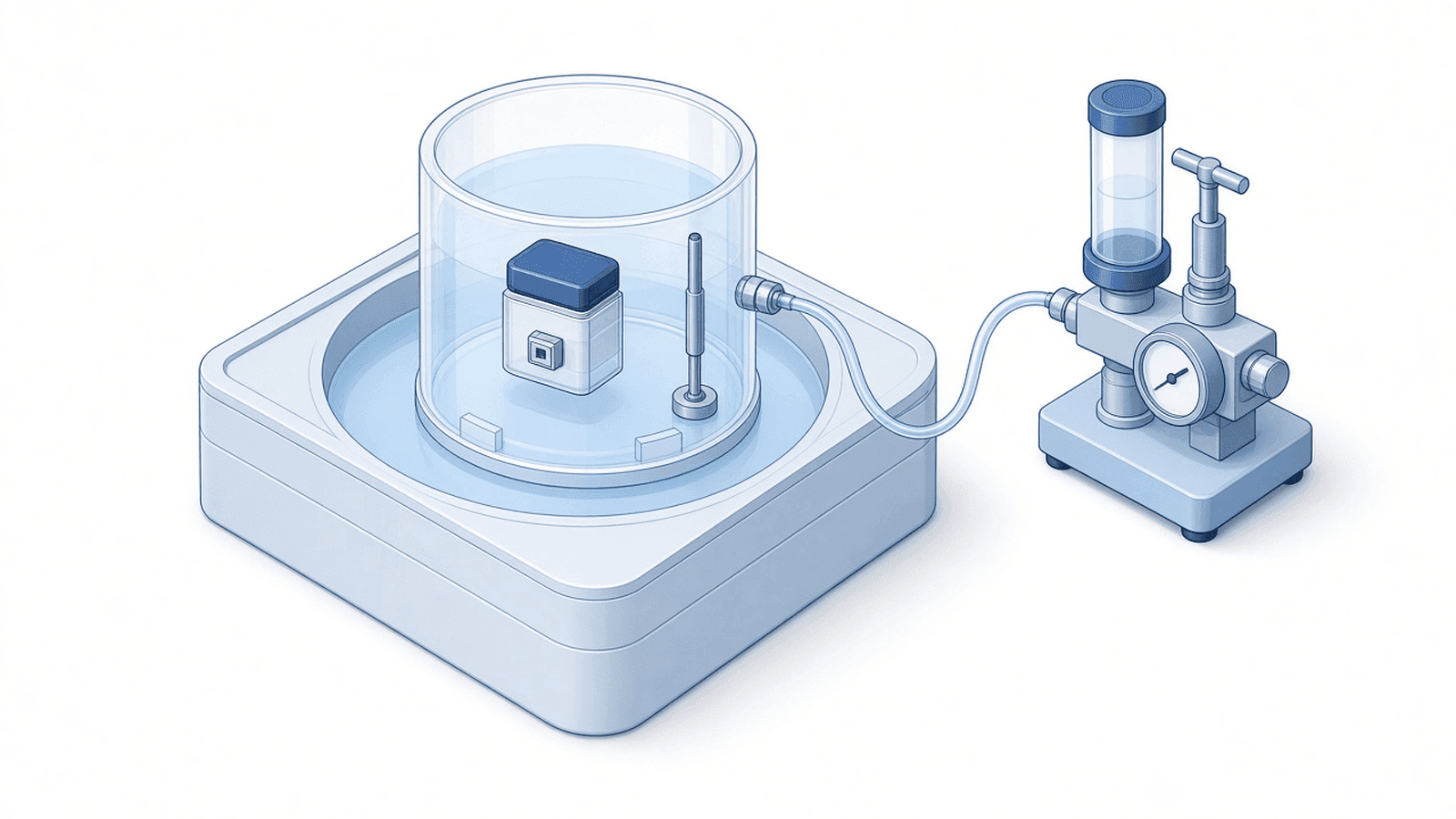
An evaluator can ask the supplier to explain the relationship between its claimed period and its actual exposure. The useful response identifies the protocol revision, conditions, exposure duration, model assumptions and their supporting rationale. Ask how the materials and finished assembly were represented, and how temperature, moisture or other conditions were chosen for this configuration. Record the explanation alongside the test report so later reviewers can reconstruct the reasoning.
- Check the time covered by each report. A proposed study endpoint and a completed exposure should have distinct entries in the record.
- Ask whether the protocol and report use the same assumptions. If there was a revision, request the impact assessment and the report that closes it.
- Record how distribution and other conditioning were incorporated into the evidence program. Ask for the sequence actually used and its rationale.
- Refer an unexplained modeling choice or material response to the qualified technical reviewer. Resolve the specific uncertainty before accepting the claimed coverage.
Which catheter functions were checked after aging?
FDA’s 2024 town hall describes two shelf-life components for 510(k) review, covering the barrier over the claimed duration and performance testing of aged product. The discussion places aged-product performance in the submission’s performance-testing section. This provides a useful structure for the hospital’s evidence map.2
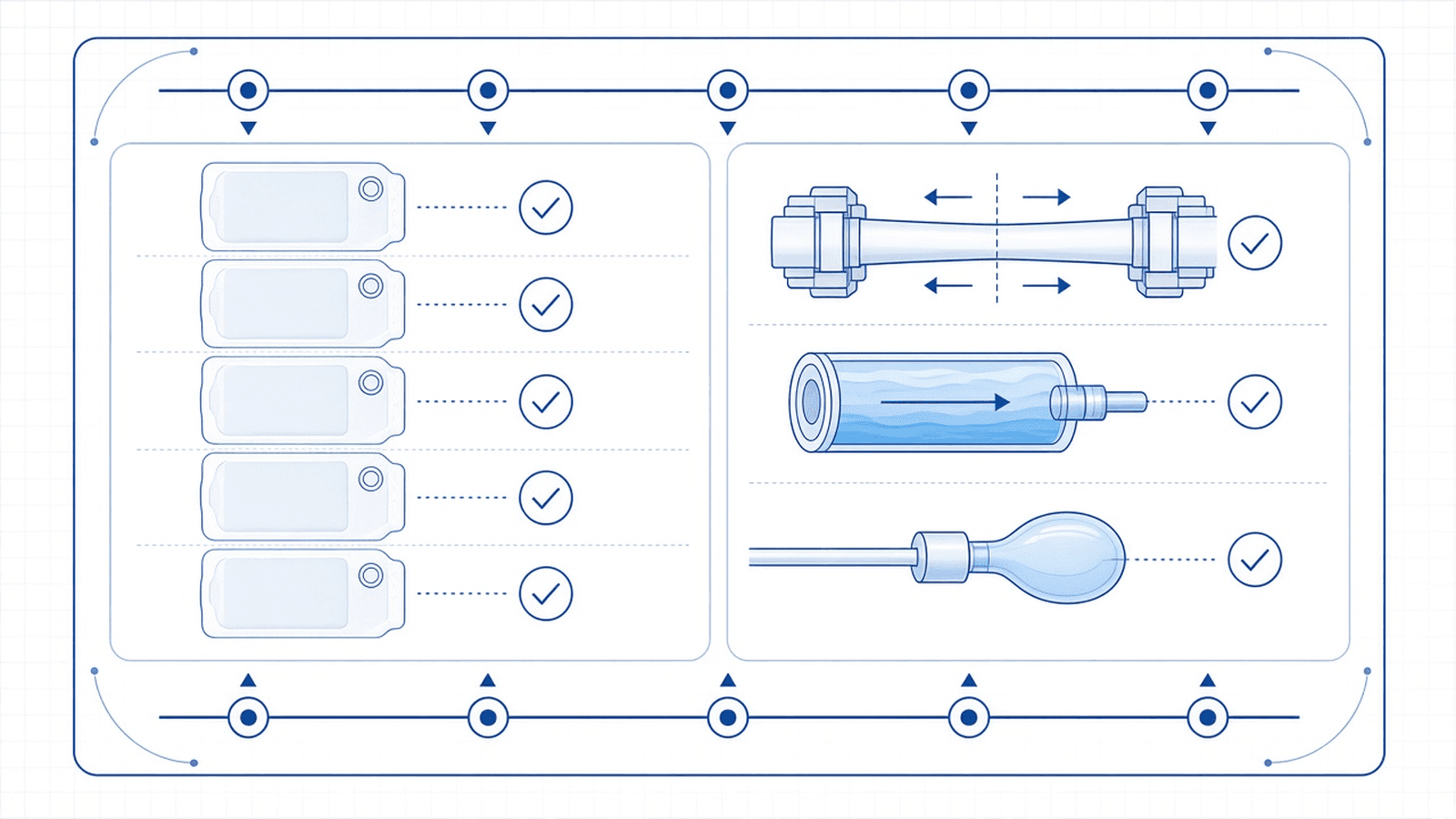
For each relevant catheter feature, ask which result addresses retained performance after storage. Give the endpoint, configuration, aging timepoint and report reference their own cells. The following table proposes questions for reading a dossier. The supplier’s design, risk assessment, applicable methods and specifications determine the actual testing program.
| Feature on the offered catheter | Function evidence to locate | Coverage question | Record with the result |
|---|---|---|---|
| Shaft and drainage path | Relevant mechanical and drainage-performance results | Which finished configuration and conditioning does the result represent? | Method, endpoint, sample identity, aging timepoint and result reference |
| Retention balloon on a Foley design | Balloon-performance evidence relevant to the offered design | Were the applicable balloon functions assessed on aged samples? | Device size, test conditions and interpretation against the stated specification |
| Balloon-free retention feature | Design-specific retention-performance evidence | How does the endpoint represent the actual retention architecture? | Supplier rationale, assessed feature and report scope |
| Integrated drainage valve | Design-specific opening, closure or drainage-performance evidence | Does the report cover the valve in the offered configuration after storage? | Component and assembly identity, endpoint and coverage rationale |
| Hydrophilic coating | Evidence addressing the claimed coating properties after storage | Which coating, catheter and conditioning were represented? | Property assessed, method, timepoint and result reference |
| Included accessory or collection component | Relevant evidence for the supplied system and its claimed functions | Does the summary identify which components were assessed? | Included-item list and any justified representative coverage |
Source: Editorial review questions. FDA’s historical Foley guidance supplies catheter-specific function and coating examples in Section XI (reference 5). This map adapts those questions to the offered design.
The September 1994 FDA Foley guidance explicitly discusses storage and adverse-shipping effects on hydrophilic coating properties in Section XI. It also discusses drainage and balloon performance. Read these as dated US Foley examples when deciding which feature-specific evidence to request. A catheter with a different retention architecture needs a rationale tied to that architecture.5
Close the function review at the level of the claim. Record any endpoint still awaiting an aged result, any offered feature absent from the report, and any bridging explanation awaiting assessment. A completed packaging report can stay in the file while the function question remains open. Keeping those dispositions explicit helps the committee avoid giving one document more scope than its results support.
How much real-time follow-up is complete?
Build a dated record of actual real-time progress. The four descriptions below are proposed workflow states for a purchasing review. Assign a state to the particular configuration, endpoint and timepoint being assessed. A dossier can have completed packaging checkpoints and unresolved functional coverage at the same meeting.
- Confirmed through the claimed period. The identified real-time program has reached the relevant final endpoint and the reviewer has assessed the available results for that scope.
- Pending under an active protocol. Record completed checkpoints, their results, the next scheduled checkpoint and expected report availability. An initial study can be active before its first checkpoint is due.
- Update required. A scheduled result or status report is missing, delayed or inconsistent with the submitted schedule. Request the actual study status and reason for the difference.
- Coverage unresolved. The supplied documents leave the offered configuration, endpoint or confirmation plan unclear. Record the missing evidence and the person responsible for obtaining it.
Use both a test date and a report-status field. A sample pull may have occurred while report approval is still pending. Conversely, the presence of an approved interim report says little about a later scheduled checkpoint unless its status is recorded. This distinction lets the committee ask a precise follow-up question and preserves the evidence available when it made its decision.
An active confirmation study can accompany a technically justified initial claim.3 The status label is one input to the hospital’s decision. Record what the qualified reviewer accepted, the scope of that acceptance, any conditions and the date for reassessment. If results change or a checkpoint is delayed, assess the effect on the original claim and record the resulting action.
What do public catheter submission summaries actually reveal?
Two public US submissions illustrate what a buyer can observe before requesting supplier-specific support. Their FDA letters establish the clearance decisions for those named devices. The manufacturer-authored summaries describe their testing. The examples concern different catheter configurations and provide documentation context for this review.
- InnoCare Specialty Foley Catheter, K241424. The summary was prepared May 17, 2024 and accompanies a September 18, 2024 clearance letter. Section 7 reports performance and package-integrity testing after environmental conditioning, simulated distribution and accelerated aging. The summary leaves the aging settings, detailed sample results and current real-time milestones unreported. A buyer can request those fields if they are material to the offered claim.7
- Coloplast SpeediCath Flex Set, K222059. The September 19, 2022 summary describes a male intermittent catheter set with an integrated collection bag. Its performance list includes real-time and accelerated-aging shelf-life testing to ASTM F1980-16. The public list leaves the detailed timepoints and component-level aging results unobserved. Record the historical edition actually reported when reading this example.8
| Review question | Public observation | Focused follow-up |
|---|---|---|
| Which aging approaches are named? | K241424 names accelerated aging. K222059 lists accelerated and real-time testing. | Request actual completed timepoints and the current confirmation status for the offer. |
| Is post-conditioning function mentioned? | K241424 explicitly links performance and package integrity to conditioning and aging. | Locate the actual aged-function endpoints and their covered configurations. |
| Which standard edition is visible? | K222059 names F1980-16 in its testing list. | Record the edition used and ask the responsible reviewer to assess current applicability. |
| Does the record resolve the present purchasing question? | The summaries describe the named submissions and omit substantial technical detail. | Ask for the specific gap to be resolved through a summary, report or controlled technical review. |
Source: Focused reading of manufacturer summaries K241424 and K222059 (references 7 and 8). Unreported details remain unobserved.
Tailor the request to the uncertainty. A signed, revision-controlled summary may answer a straightforward timepoint question. A configuration discrepancy or unexplained result may justify access to the relevant complete report. Agree controlled access or a redacted summary where confidentiality affects document sharing. Record what the reviewer could inspect and whether that access was adequate to resolve the gap.
How should the reviewer record missing coverage or a changed configuration?
FDA’s 2019 bench-reporting guidance recommends identifying samples, conditioning, sample-selection rationale, methods, assessment criteria, results and significant deviations. It also addresses the rationale when representative samples support a device family. These nonbinding US submission recommendations provide useful document-reading fields for the proposed register.6
A supplier may justify representative coverage for a family using its design and risk analysis. Ask which characteristics make the selected sample relevant to each claimed endpoint, including any differences introduced by the quoted configuration. The worst-case rationale may vary across endpoints. Record the explanation and the technical reviewer’s disposition for each material uncertainty.
For an already US-cleared device, FDA’s 2017 change guidance, Section B4/B4.1, asks whether the supporting method or protocol was described in a previously cleared 510(k). It generally points to documentation when that basis continues, and says a new 510(k) is likely when a new supporting method or protocol is used. It also allows for updates reflecting newly recognized standard versions. Its current cover directs manufacturers to the QMSR effective February 2, 2026. The responsible regulatory reviewer should assess the complete change in the applicable jurisdiction.9
Use the following nine fields for the expiry review. Add one entry per endpoint or report when coverage differs. Keep the quotation, label revision and review date with the register so a later document update can be related to the decision it changes.
| Field | Record | Question to resolve |
|---|---|---|
| Offered configuration | Catalogue identifier, included components and packaging revision | Which tested sample or representative rationale covers this offer? |
| Expiry claim | Storage period, starting event, conditions and label revision | Does the claim match the evidence being assessed? |
| Test article and conditioning | Finished-device status and relevant processing or exposure references | How are differences from the offered system justified? |
| Aging rationale | Protocol revision, conditions, duration, assumptions and rationale reference | Can the reviewer trace how exposure supports the claimed period? |
| Accelerated result | Completed exposure, endpoint, report revision, result and deviations | Which part of the claim does this result cover? |
| Real-time progress | Start date, completed checkpoints, report status and next planned result | What evidence is available at this review date? |
| Aged-device function | Applicable feature, endpoint, sample and timepoint | Is the function claim covered for the offered configuration? |
| Remaining gap | Missing result, scope difference or pending technical explanation | What specific response would resolve it? |
| Disposition and owner | Review decision, accepted scope, responsible person and next review date | Who follows the outstanding evidence through closure? |
Source: Silicon Life editorial synthesis. Proposed purchasing fields informed by references 1–9, for adaptation by the hospital’s qualified reviewers.
Consider a hypothetical offer for a catheter with an integrated drainage valve. The supplier submits an aging summary for the pouch, a functional report for an earlier configuration, and a real-time schedule showing an interim checkpoint already due. The submitted package leaves the actual checkpoint result and aged-valve coverage unclear. Record those as two specific requests, keeping the completed document references available for review.
The buyer asks for the current real-time status and either relevant aged-function results or a justified bridge from the tested configuration. The technical reviewer then assesses whether that bridge covers the changed feature, assembly and exposure. Until the questions are resolved, the example’s disposition remains clarification required. The clinical-use decision follows the hospital’s approved governance and local eligibility review.
When a response arrives, update the same record with its revision, the coverage it establishes and any remaining limitation. Close the gap only to that scope, and retain ownership of later checkpoints. This gives the next reviewer a reasoned decision history without presuming any defect, successful test or clinical outcome for a real supplier.
Where Silicon Life fits
Silicon Life develops the balloon-free Disposable Sterile Controlled Catheter discussed within this purchasing category. It is registered in China only as a Class II device, under 鄂械注准20252145807, for female patients with voiding dysfunction. Its configuration requires product-specific evidence review.10
Hospital teams evaluating that China-only Class II catheter for women with voiding dysfunction can review the controlled-catheter product scope and request its current IFU, label and applicable shelf-life evidence references. The offered documentation and its coverage remain questions for the actual evaluation. Silicon Life’s pipeline programmes remain investigational.11
Review scope, November 11, 2026. This focused narrative appraisal uses public source passages and two manufacturer summaries. The worksheet is an editorial synthesis. Supplier dossiers, raw test results and a company-specific shelf-life claim were unavailable for assessment. Revisit the record when a standard or guidance changes, the offered configuration changes, a checkpoint is completed or contradictory results emerge.
Frequently asked questions
Can accelerated aging support an expiry claim before real-time follow-up ends?
ASTM’s public scope permits initial support from accelerated evidence while real-time confirmation continues. For the particular offer, ask for the completed results, applicability rationale and active confirmation schedule. Have the qualified reviewer determine whether the evidence supports the claim at the current decision date.3
Does a package result establish retained catheter function?
Package evidence addresses its stated barrier or seal endpoint. Locate aged-catheter performance evidence for the relevant functions alongside it. FDA’s 2024 town hall treats both as parts of the shelf-life evaluation.2
Can one tested model represent an entire product family?
Representative testing can support a family when the selection and coverage are justified. FDA’s bench guidance recommends a rationale for sample selection. Request the rationale tied to the actual offered models and endpoints, and record the technical reviewer’s assessment.6
Can an aging-chamber temperature establish the label's storage conditions?
Obtain the manufacturer’s actual labeled storage conditions and supporting rationale. ASTM F1980-21 scope 1.7 expressly limits the use of accelerated-aging data for establishing sterile-barrier label storage conditions. Read the chamber exposure as part of the documented aging method.3
Does every shelf-life extension require a new US 510(k)?
For an already US-cleared device, assess the complete change using FDA’s guidance. Section B4/B4.1 considers continuity of the previously described method or protocol and includes a qualification for newly recognized standard versions. Keep the manufacturer’s regulatory assessment with the changed claim and the applicable supporting evidence.9
References
- 1FDA CDRH. Shelf Life of Medical Devices. April 1991. Division of Small Manufacturers Assistance, Center for Devices and Radiological Health.
- 2FDA CDRH. Medical Device Sterilization Town Hall Transcript. February 7, 2024. Center for Devices and Radiological Health.
- 3ASTM International. ASTM F1980-21: Standard Guide for Accelerated Aging of Sterile Barrier Systems and Medical Devices. Active Standard, December 21, 2021.
- 4FDA CDRH. Recognized Consensus Standards Database: Recognition Record 14-575 for ASTM F1980-21. February 20, 2023.
- 5FDA CDRH. Guidance for the Content of Premarket Notifications for Conventional and Antimicrobial Foley Catheters. September 1994.
- 6FDA CDRH and CBER. Recommended Content and Format of Non-Clinical Bench Performance Testing Information in Premarket Submissions. Guidance for Industry and Food and Drug Administration Staff, December 20, 2019.
- 7InnoCare Urologics, LLC. InnoCare Specialty Foley Catheter 510(k) Summary K241424. May 17, 2024 (FDA clearance letter September 18, 2024).
- 8Coloplast A/S. SpeediCath Flex Set 510(k) Summary K222059. September 19, 2022.
- 9FDA CDRH and CBER. Deciding When to Submit a 510(k) for a Change to an Existing Device. Guidance for Industry and Food and Drug Administration Staff, October 25, 2017.
- 10Silicon Life. Disposable Sterile Controlled Catheter public product overview. Product and regulatory scope. Accessed November 11, 2026.
- 11Silicon Life. Investigational pipeline overview. Accessed November 11, 2026.
Silicon Life. Catheter shelf life evidence for packaging and device function. SILICON·LIFE Insights. 11 November 2026.

Silicon Life develops urological devices and implantable systems in Wuhan, China. Its Insights are written for healthcare professionals, with the sources for each article listed in full.
This article is provided for educational purposes for healthcare professionals. It does not constitute medical advice and does not replace the Instructions for Use of any device. Product availability and indications differ by country.
New articles on urology devices and implant engineering.
Clinical reviews, engineering notes and company news from Silicon Life, sent when new articles are published.
Occasional emails. Unsubscribe at any time.