
This guide is for hospital value-analysis committees, procurement officers, clinical engineers and distribution teams screening an adult indwelling catheter offer. Imagine a bidder offering a familiar-looking catheter with a new coating or drainage feature. Its dossier includes a market document, a test certificate, nursing feedback and projected savings. Those items answer different questions. A useful RFQ makes the bidder identify which document supports which part of the offer before a hospital commits staff time to evaluation.
The practical output is one evidence register linked to an eleven-domain request matrix. It helps the committee distinguish an unresolved eligibility issue from an unsupported optional benefit or a negotiable commercial term. That distinction matters: a missing local authorization cannot be offset by a high usability score, while an unsubstantiated premium claim may be removed from scoring without implying that every aspect of the device is defective.
What belongs in the file: eligibility evidence or claim evidence?
Open two linked sections in the purchasing file. Give each a named reviewer and a written disposition: supported within a defined scope, clarification required, or unsuitable for the proposed use. Keep the offered item and document version visible in both:
- Eligibility: Which destination-market route covers the offered device, intended use and population? What documents connect the quotation, manufacturer, catalogue number, label and IFU?
- Claim support: What evidence supports each performance or workflow promise for this configuration? Does it establish the claimed endpoint, or merely a related laboratory result or user preference?
For the United States, FDA describes 510(k) clearance as a substantial-equivalence determination, rather than a finding that a device is superior to its comparator.10 For the EU example, MDCG 2021-27 Rev.1 explains checks for importers and distributors under the MDR and IVDR. These documents concern different regulatory frameworks; use the destination-market reviewer to identify the applicable route instead of treating one country’s document as a worldwide purchasing credential.7
EU role matters. MDCG’s nonbinding Q&A describes distributor checks for CE marking and an EU declaration of conformity, manufacturer information, importer identification and UDI assignment where applicable. Some checks permit representative sampling. It also notes that hospital pharmacies circulating devices solely for internal hospital use are not distributors on that basis. Do not assign every receiving hospital the legal duties of a distributor. The procurement adaptation here is to identify the actual economic operators and request evidence appropriate to their roles.7
Ask the bidder for a cross-reference between each offered catalogue number and the applicable authorization documentation, label and IFU. Assess family-level documents through their full supporting record; an absent commercial code on one document is a question for the regulatory reviewer, not a complete coverage assessment. The question is whether the offered configuration is demonstrably covered. If the mapping is unclear, ask the regulatory reviewer to resolve it before use. For substrate, latex and coating claims, use the companion silicone versus latex evidence checklist; this matrix addresses the wider vendor file.
What does a complete bench-test submission look like?
FDA’s December 2019 bench-testing guidance distinguishes summaries from complete reports. It is nonbinding US submission guidance, which this article adapts as a document-reading aid rather than a purchasing obligation.1
For a mechanical or flow claim, request a summary that makes the following items inspectable. Seek the supporting report when a material gap remains; not every RFQ requires proprietary raw data.
- Identity: Test title, objective, device configuration and report reference.
- Method: Protocol or standard edition, conditions, sample size and relevance of the samples to the offered design.
- Assessment: Predefined acceptance criteria where applicable; characterization tests may instead explain how results are interpreted.
- Results: Suitable quantitative or categorical summaries, whether criteria were met, and explanations of consequential deviations or failures.
- Conclusion and access: What the findings support, their limitations, and where the complete report can be located or reviewed.1
Keep catheter-specific benchmarks in scope. FDA’s August 2020 Safety and Performance Based Pathway guidance concerns conventional two-lumen balloon Foley catheters, Fr 12–26, with balloon volume no greater than 30 cm³ and indwelling time of 30 days or less. It excludes antimicrobial, lubricity-treated, suprapubic and three-lumen devices. Its mechanical domains include dimensions, drainage flow, balloon integrity, traction response, volume maintenance and deflation reliability. These are scoped submission benchmarks, not universal tender thresholds or evidence that another design meets them.2
An evaluator should ask whether the test article represents the offered configuration and the claimed conditions. A flow result from one geometry does not automatically substantiate another. Record what was tested, what changed and the supplier’s bridging explanation. Treat an unexplained “pass” as a clarification request; a qualitative test need not have a mean and standard deviation, and a summary need not reproduce every raw measurement.
What do standards declarations prove — and not prove?
A standards declaration needs an edition, scope and extent of conformity. FDA’s public ISO 20696:2018 entry (corrected December 2019) shows partial recognition: balloon volume maintenance, deflation reliability, flow rate and balloon integrity provisions are excluded because of conflicts with specified FDA guidance or ASTM methods. That does not itself invalidate a cleared device or establish that every FDA method is more stringent.3
The same entry describes sterile single-use urethral catheters with or without a balloon, while excluding drainage families such as suprapubic catheters covered by ISO 20697. Ask the reviewer how the declared standard and any alternative evidence cover the offered design. Recognition is jurisdiction-specific; this review uses the public entry, not the licensed standard text, and supplies no ISO test thresholds.3
Which purchasing-relevant calls does clinical guidance actually make?
CDC’s March 2024 page summarizes its underlying 2009 CAUTI guideline. The following recommendations can inform questions for the clinical team; they do not prescribe stock quantities or a universal catheter size.4
- Size and drainage: CDC suggests considering the smallest bore consistent with good drainage (Category II), and preconnected sealed catheter–tubing junctions (Category II). It recommends maintaining a closed drainage system (Category IB).4
- Features and replacement: Complex drainage systems are unnecessary for routine use; routine fixed-interval catheter or bag changes are not recommended (both Category II). Keep the clinical policy and device-specific IFU distinct from the supplier’s consumption forecast.4
- Antimicrobial claims: If CAUTI rates are not decreasing after a comprehensive prevention strategy, CDC recommends considering antimicrobial/antiseptic-impregnated catheters (Category IB), while identifying symptomatic-UTI benefit and the populations most likely to benefit as research questions.4
For purchasing, the implication is to ask what problem a premium feature is intended to solve and what evidence supports that endpoint. Avoid turning a conditional recommendation into a blanket specification. The separate review of retention and valve drainage addresses those clinical comparisons; the RFQ should request the relevant evidence rather than promise an infection benefit.
The vendor-neutral RFQ evidence-request matrix
Table 1 is an author-proposed request tool. The jurisdiction column identifies context rather than declaring global compliance. Its final column lists reasons to clarify, hold use or investigate; these are not automatic legal disqualifiers. Local clinical, quality and procurement teams should approve the request fields and decision rules before issuing the RFQ.
| Evidence domain | Document or field to request | Jurisdiction / scope | Review stage | Gap and proposed next action |
|---|---|---|---|---|
| 1. Market eligibility | Applicable authorization documents and a mapping to the offered model and indication.710 | Destination market; regulatory reviewer confirms route and operator roles | Before in-use evaluation | Wrong market or unclear model coverage: hold use pending documented resolution. A family document alone is not grounds for rejection. |
| 2. Intended use and configuration | Catalogue number, current label and IFU revision, construction and approved substitution list. | Destination-market information; buyer-defined configuration | Before in-use evaluation | Quotation, label and sample differ: request reconciliation and review of the exact item. |
| 3. Clinical evidence register | Per benefit: full study reference, population, design, endpoint, comparator, follow-up and withdrawals. | Claim and intended population; proposed evidence fields | Claim scoring | Single-arm satisfaction presented as comparative efficacy: remove the unsupported inference and record the remaining question. |
| 4. Bench summaries | Test identity, methods, sample rationale, assessment criteria, results, deviations and report access.1 | FDA reporting guidance is a nonbinding US example | Technical review | Unexplained failures or relevance gaps: seek the supporting report and technical interpretation. |
| 5. Standards declarations | Edition, clauses, conformity extent and alternative evidence for uncovered requirements.3 | Recognition and applicability vary by regulator | Technical review | A generic ISO statement does not answer a design-specific question: request the missing mapping. |
| 6. Sterilization, packaging and shelf life | Method, validation references, package configuration, expiry basis and supporting evidence identifiers.2 | FDA Foley guidance is a scoped example; local quality review required | Before use; receiving planning | An unsupported sterile configuration or expiry claim needs quality resolution. This row is not a validation protocol. |
| 7. Biocompatibility | Evaluation summary for actual materials, tissue contact, duration and final device configuration.2 | Design-specific assessment; use applicable local requirements | Technical review | An evaluation for a different exposure duration needs justification, not an assumed transfer. |
| 8. Supply and change control | Lead times, backorder plan, agreed substitution process and written change-notification terms. | Negotiated commercial fields | Contracting | Undefined substitution authority: agree review responsibilities and notification terms before ordering. |
| 9. Complaints and safety history | Quality contact, complaint escalation, and dated recall / field-action disclosure for the item.7 | Applicable national reporting duties; EU operator guidance is an example | Before pilot and contracting | Missing or inconsistent disclosure needs follow-up. No known recalls can be a valid response; absence of reports is not proof of safety. |
| 10. Training and governance | IFU-aligned training, named hospital lead, approved evaluation plan and close-out criteria.5 | Institutional policy; AST offers a US perioperative example | Pilot approval and close-out | Unclear oversight or research classification: obtain the institution’s determination before starting. |
| 11. Cost transparency | Unit and accessory prices, training inputs, and separately labelled workflow assumptions. | Proposed commercial fields; no savings estimate | Financial review | Unmeasured outcome savings: exclude them from demonstrated benefits and retain assumptions for later appraisal. |
Source: Editorial synthesis. Inline references identify source context; commercial terms and disposition suggestions are proposed purchasing fields, not regulatory mandates.
Add a response register beside the matrix: offered code, document title and revision, claim supported, gap, responsible reviewer, clarification due date and disposition. Set due dates through the tender’s own rules. Separate “not supplied”, “not applicable with rationale” and “supplied but insufficient”. A documented alternative can be appropriate; accepting it should require a reason, not an unchecked box. Do not average a critical eligibility gap into a weighted commercial score.
Who should govern the hospital pilot?
The AST guideline, revised April 2017 for US surgical departments, recommends a selection plan with a multidisciplinary team, predetermined criteria, anonymous evaluation forms, a defined evaluation period, analysis and follow-up. It distinguishes product evaluation from a clinical trial and advises considering factors beyond acquisition cost. It defers policy authority to the healthcare organization.5
That distinction does not classify a proposed project under research law or institutional ethics policy. Obtain a determination from the hospital’s appropriate governance, research or ethics office before starting, especially where the plan changes intended use, assigns interventions or seeks generalizable outcomes. A familiar product or a procurement label does not settle that question. The following is a proposed operating record, not a claim that AST defines a legal exemption:
- Ownership: Name the hospital decision-maker, clinical lead, quality contact and data custodian. Record the vendor’s role and any support or funding. Keep hospital control of analysis and conclusions.
- Question and boundaries: State the purchasing question, eligible configuration, locally authorized use and approved review pathway. Agree stop-and-escalate criteria with clinical and quality leads.
- Feedback and safety records: Staff feedback may be anonymous, but anonymity must not prevent patient care, incident investigation or required reporting. Keep necessary clinical records in the hospital’s approved systems, with appropriate access and privacy controls.
- Exposure and missing feedback: Record devices issued, devices actually used, returned forms and reasons evaluation stopped. A handful of favourable forms with an unknown response denominator is weak evidence for broad acceptance.
- Time and decision: Set a feasible evaluation window and close-out date locally. Analyse usability, training and unresolved issues alongside price. There is no universal pilot duration supplied by this framework.
- Communication: Agree how results may be shared. Staff preference does not establish clinical superiority or CAUTI reduction; any external claim needs evidence appropriate to that claim and an agreed account of limitations.
For the distinct question of which outcomes matter when assessing novel bladder-emptying systems, see the bladder-emptying architecture evidence review. Its proposed endpoint domains do not replace the hospital’s project-classification decision or the vendor document checks here.
What happens when documents and the offer disagree?
Use an exception log to turn a discrepancy into a decision the next reviewer can reconstruct. The examples below illustrate the proposed workflow; they are hypothetical and impose no statutory response or notice periods.
Example 1: A quotation uses a code absent from the document supplied. Hold that line from in-use evaluation while the supplier explains the connection between the offered configuration and the applicable documentation. The regulatory reviewer can accept a justified family mapping, request further evidence or reject an uncovered item under the tender rules. Record which document resolved the question and who accepted it. Have the local regulatory reviewer determine whether the existing documentation establishes coverage or further action is needed.
Example 2: A delivery contains a different configuration. Compare it with the agreed order and approved alternatives. Route a discrepancy through receiving, quality and the clinical owner before release. Kinmed’s commercial checklist already provides useful configuration-control and exception-log concepts; it is a baseline for comparison, not authority for a universal contract deadline.6 Agree notice, approval and remedy terms explicitly. Do not infer that every material or manufacturing change requires the same notice period in every market.
Example 3: Projected outcome savings are presented as established. Keep quoted prices and documented resource inputs separate from assumed reductions in infection, replacements or staff time. Ask for the calculation, source population and attribution method. A local surveillance trend may identify a question, but it does not by itself show that a new catheter caused the change. The RFQ can record the hypothesis without scoring it as a demonstrated saving. This article supplies no cost model or claimed saving.
Public checks should serve a defined question. FDA describes AccessGUDID as a public device-identification resource, with identifiers and premarket submission numbers; GUDID does not store the actual lot or serial-number production identifiers. Compare the record with the offered label and investigate inconsistencies rather than treating a database listing as quality certification.812 If the review uses MAUDE reports, preserve FDA’s limitation: passive reports cannot establish incidence, causality or comparative adverse-event rates. A blank search does not establish safety.11
Where Silicon Life fits: scope and remaining evidence requests
Publisher relationship: Silicon Life develops a balloon-free controlled catheter in the category discussed here. This article does not certify its product against the matrix. The public company page establishes scope and describes a study; a purchasing committee would still need the relevant IFU, supporting reports and local eligibility review.
- Eligibility: The Disposable Sterile Controlled Catheter is registered in China only as a Class II device by the Hubei Medical Products Administration under China’s NMPA framework (鄂械注准20252145807), for female patients with voiding dysfunction. It is not indicated for men and is not registered, cleared or approved for sale in any other market.9
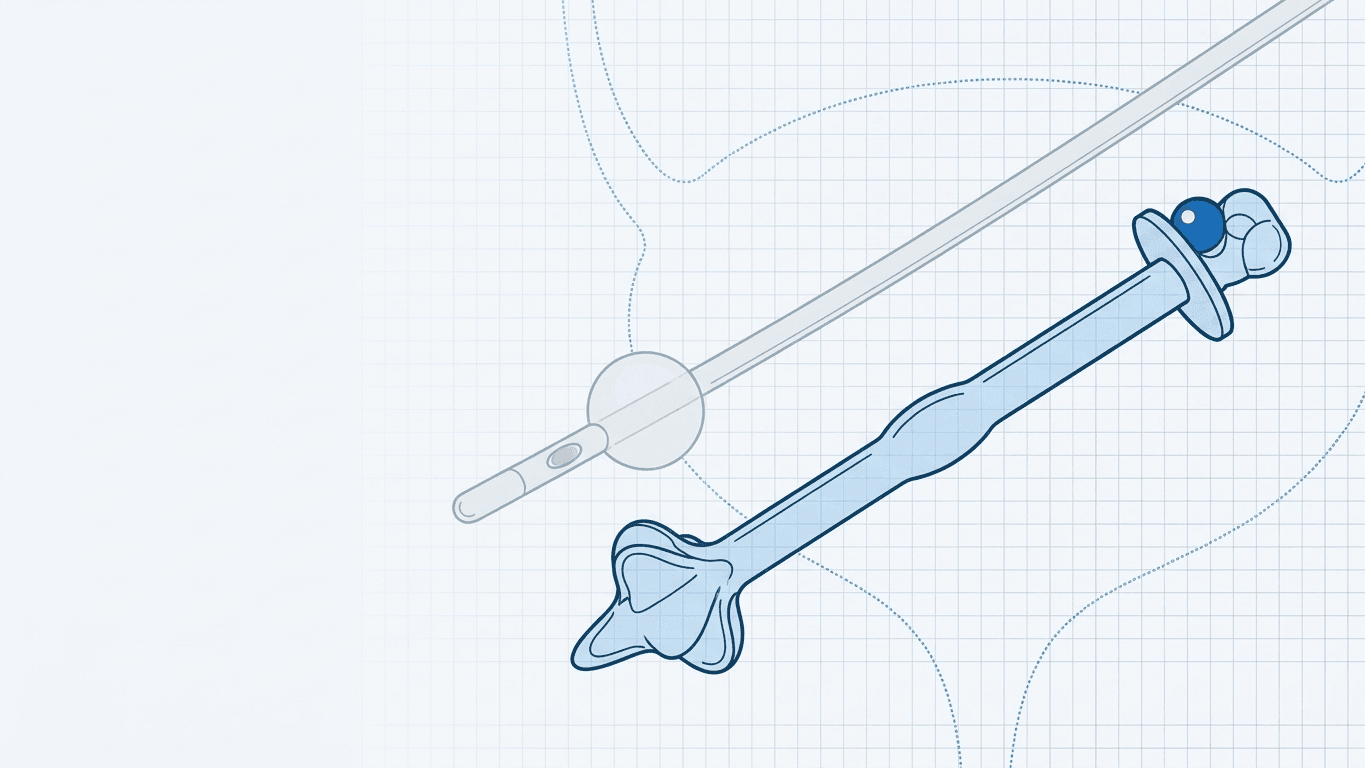
- Configuration: Its silicone-rubber shaft, PTFE ball-bead valve and balloon-free retention mechanism require evidence appropriate to that design. Conventional balloon-Foley results do not establish its comparative performance.9
- Clinical claim limits: The company-reported evidence is one interventional, single-centre, single-arm study: 23 enrolled, 19 completed, with four withdrawals after dislodgement or removal for discomfort. Only two models were studied. There is no comparative proof of superiority or infection-rate advantage. Request the full report before extending any finding to an offered configuration.9
- Pipeline: Silicon Life’s pipeline programmes remain investigational and are not available for sale; they should not be treated as eligible commercial alternatives in this RFQ.13
Healthcare professionals can request the IFU and clinical study report through the controlled-catheter product page or a documentation and distribution enquiry. These requests are for evaluation: the catheter’s registration remains China-only, Class II, for female voiding dysfunction. Programmes described on the investigational pipeline page remain in development.
Review scope, 28 October 2026: This is a focused narrative synthesis and proposed purchasing tool, not a systematic review, validated scoring model or complete jurisdictional compliance checklist. It uses the named FDA guidances, the public standards-recognition record, CDC’s underlying 2009 guidance on its 2024 summary page, AST’s 2017 perioperative guideline and MDCG’s December 2023 Q&A. Recheck the applicable source versions, product documentation and local governance requirements when issuing an RFQ or reviewing a changed offer.
Frequently asked questions
Is a CE mark, FDA clearance or ISO certificate alone enough to accept a catheter bid?
No single document settles the whole purchasing decision. Check the applicable market route and the offered use, then assess the claims and workflow separately. A standards conformity statement should identify its edition and extent; FDA’s ISO 20696 record illustrates why regulator recognition and a generic ISO claim are different questions.3
Does FDA clearance matter if our hospital is outside the United States?
It can be relevant supporting evidence, but it does not by itself establish local eligibility. Ask the destination-market reviewer whether that jurisdiction uses foreign evidence or recognition pathways and what local steps remain. FDA guidance can also inform technical questions, provided its US scope and nonbinding status remain visible. Do not equate “not sufficient by itself” with “irrelevant everywhere”.
Can a smooth in-use product evaluation replace clinical evidence?
No. Handling feedback can reveal workflow and training problems, but cannot supply an unmeasured infection endpoint or a missing comparator. Even favourable feedback should show who responded, exposure, missing forms and early discontinuation. If the proposed activity seeks clinical outcomes, obtain the appropriate institutional determination and evidence plan rather than assuming it remains an ordinary product evaluation.
Should our tender specify antimicrobial-impregnated catheters by default?
Do not read the cited CDC recommendation as a blanket tender instruction. It describes consideration after a comprehensive prevention strategy has failed to reduce CAUTI rates, and retains research uncertainties. The clinical and infection-prevention team should define the local problem and assess whether the offered evidence answers it.4
What can the hospital verify itself instead of trusting the vendor's binder?
Start with the offered identity: compare its label, catalogue code, manufacturer and IFU with the submitted documentation. AccessGUDID can support US device-identification checks; it does not replace authorization review or a physical lot check.812 Ask the quality reviewer to reconcile the supplier’s dated safety-history disclosure with the relevant official records. Report counts or their absence cannot rank products by safety.11
References
- 1FDA. Recommended Content and Format of Non-Clinical Bench Performance Testing Information in Premarket Submissions. Guidance for Industry and FDA Staff, issued 20 December 2019.
- 2FDA. Conventional Foley Catheters — Performance Criteria for Safety and Performance Based Pathway. Guidance for Industry and FDA Staff, issued 14 August 2020.
- 3FDA. Recognized Consensus Standards database entry 9-143 (FR Recognition List 060): ISO 20696:2018 (Corrected 2019-12) Sterile urethral catheters for single use.
- 4CDC. Summary of Recommendations from the Guideline for Prevention of Catheter-Associated Urinary Tract Infections (2009), updated 2024.
- 5Association of Surgical Technologists. AST Guidelines for Best Practices in Urinary Catheterization, revised 14 April 2017 — Guideline IV: written plan for selection and evaluation of urinary catheter devices.
- 6Kinmed. Foley catheters procurement: a controlled configuration checklist, 23 September 2026.
- 7Medical Device Coordination Group. MDCG 2021-27 Rev.1 Questions and Answers on Articles 13 & 14 of Regulation (EU) 2017/745 and Regulation (EU) 2017/746, December 2023.
- 8FDA. UDI Basics, content current as of 17 August 2022.
- 9Silicon Life. Disposable Sterile Controlled Catheter product page.
- 10FDA. Premarket Notification 510(k): substantial equivalence and clearance.
- 11FDA. About the Manufacturer and User Facility Device Experience (MAUDE) Database: limitations of medical device reports.
- 12FDA. Global Unique Device Identification Database (GUDID): database scope and public AccessGUDID search.
- 13Silicon Life. Investigational pipeline: programmes in development, not approved or available for sale.
Silicon Life. Urinary catheter procurement: evidence to request before a hospital pilot. SILICON·LIFE Insights. 28 October 2026.

Silicon Life develops urological devices and implantable systems in Wuhan, China. Its Insights are written for healthcare professionals, with the sources for each article listed in full.
This article is provided for educational purposes for healthcare professionals. It does not constitute medical advice and does not replace the Instructions for Use of any device. Product availability and indications differ by country.
New articles on urology devices and implant engineering.
Clinical reviews, engineering notes and company news from Silicon Life, sent when new articles are published.
Occasional emails. Unsubscribe at any time.