
Disposable Sterile Controlled Catheter
One catheter a month. One touch to control.
A balloon-free indwelling urethral catheter for female patients with voiding dysfunction. A quatrefoil tip holds it in place, and an integrated ball-bead valve lets the patient or carer drain the bladder by hand, then close it again.
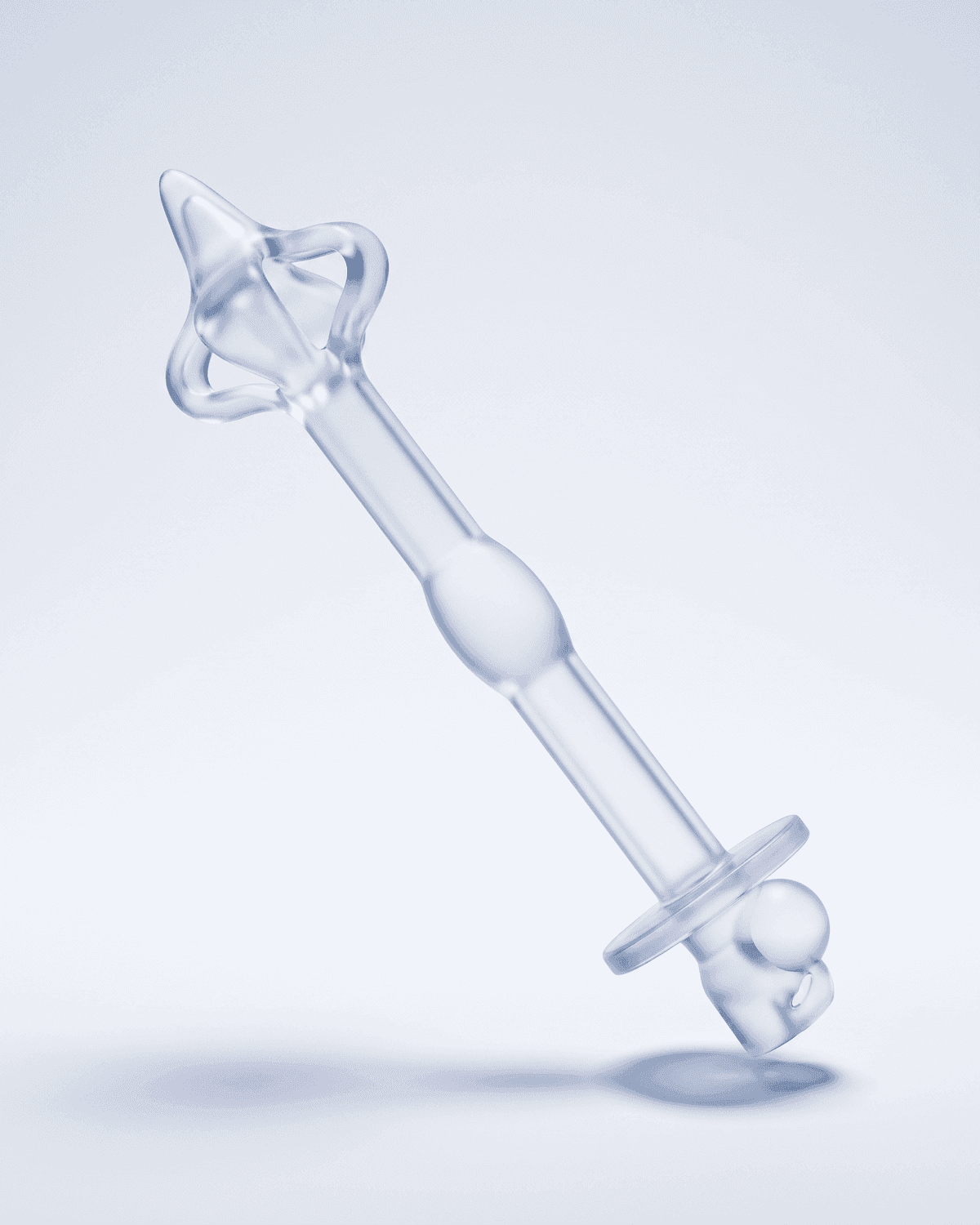
Retention without a balloon. Drainage on demand.
Conventional indwelling catheters drain continuously into a bag and are held by an inflated balloon. The Silicon Life catheter takes the opposite approach: it lowers outflow resistance only when the patient chooses to void. With the valve open, the bladder empties through the catheter under the pressure difference and gravity; with the valve closed, the catheter stays sealed between voids.
- 1Quatrefoil tipFour flexible lobes retain the catheter at the bladder neck.
- 2ShaftSilicone rubber. Effective length 35, 45 or 55 mm; Fr 12, 16 or 20.
- 3Sealing ringStandard, or reinforced on Max models.
- 4Ball-bead valvePTFE ball bead in a bulged section of the shaft.
- 5BaffleRests outside the urethral meatus and prevents migration.
- 6Push rodStainless steel (06Cr19Ni10) insertion aid, inserted from the outer end and removed after placement.
A four-lobed tip sits at the bladder neck and keeps the catheter in place without an inflatable balloon.
A PTFE ball bead seals the lumen. Moved into the bulged section of the shaft, it opens the outflow; moved back, it closes it.
The valve is operated by squeezing the outer end of the catheter. No bag, clamp or inflation syringe is needed between voids.
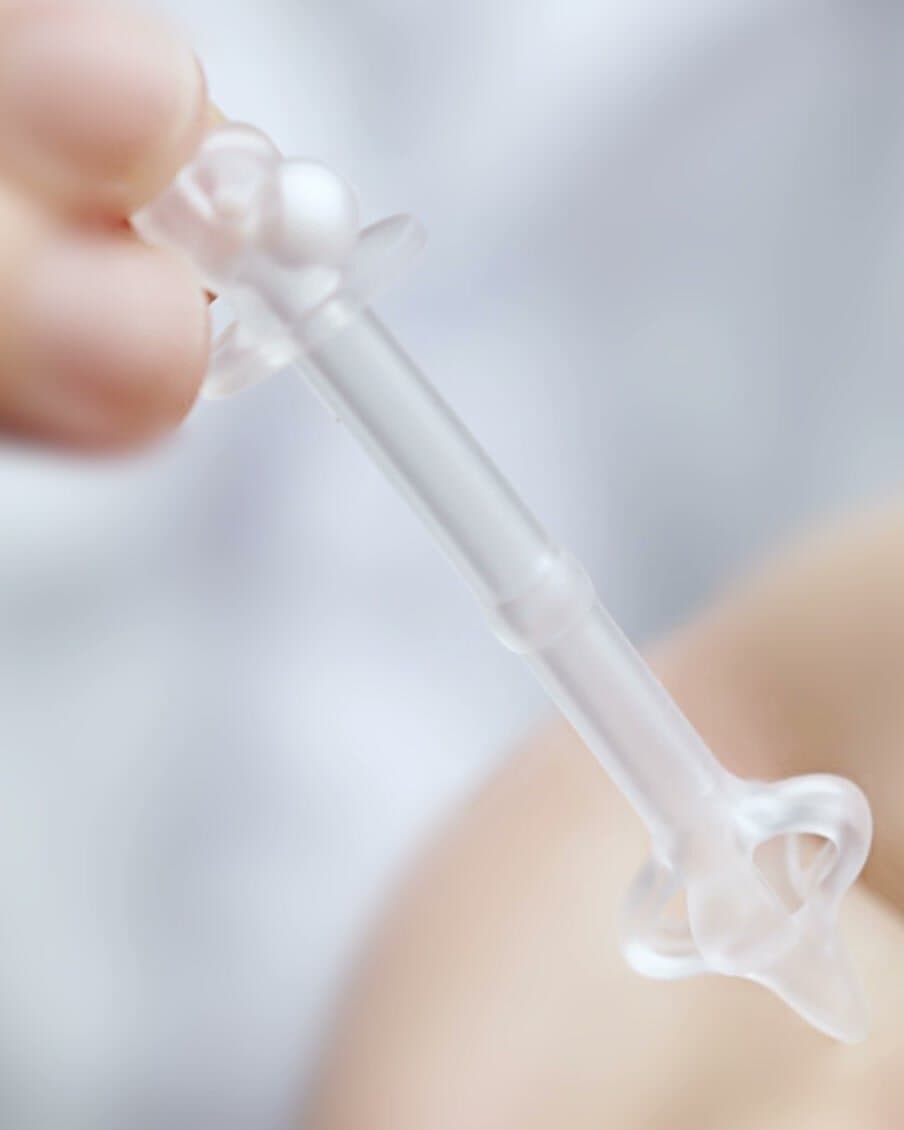
Step by step
The operation video follows the steps below. Select a step to jump to that chapter. Always follow the printed Instructions for Use.
- The catheter is placed and replaced by a healthcare professional at a medical institution.
- It remains in place for up to 30 days; the patient then returns for a new catheter.
- The patient or carer must be able to operate the valve by hand.
11 models
Three effective lengths and three French sizes. Max models add a reinforced sealing ring.
| Model | Effective length | Size | Shaft diameter | Sealing ring |
|---|---|---|---|---|
| W35-Fr12 | 35 mm | Fr 12 | 4.0 mm | Standard |
| W45-Fr12 | 45 mm | Fr 12 | 4.0 mm | Standard |
| W35-Fr16 | 35 mm | Fr 16 | 5.3 mm | Standard |
| W45-Fr16 | 45 mm | Fr 16 | 5.3 mm | Standard |
| W55-Fr16 | 55 mm | Fr 16 | 5.3 mm | Standard |
| W35-Fr20 | 35 mm | Fr 20 | 6.7 mm | Standard |
| W35-Fr20MaxMAX | 35 mm | Fr 20 | 6.7 mm | Reinforced |
| W45-Fr20 | 45 mm | Fr 20 | 6.7 mm | Standard |
| W45-Fr20MaxMAX | 45 mm | Fr 20 | 6.7 mm | Reinforced |
| W55-Fr20 | 55 mm | Fr 20 | 6.7 mm | Standard |
| W55-Fr20MaxMAX | 55 mm | Fr 20 | 6.7 mm | Reinforced |
W35, W45 and W55 give the effective shaft length in millimetres. Shaft diameter is the cylindrical shaft diameter for each French size. Select a longer length if the patient feels urethral distension, and a larger diameter if leakage occurs.
As stated on the registration certificate.
- Shaft (baffle, sealing ring, quatrefoil tip)
- Silicone rubber
- Ball bead
- Polytetrafluoroethylene (PTFE)
- Push rod
- Stainless steel 06Cr19Ni10
- Sterilisation
- Ethylene oxide; supplied sterile
Indicated for female patients with voiding dysfunction
Female patients with voiding dysfunction, including those for whom indwelling or intermittent catheterisation is being considered.
- Known allergy to any product material.
- Severe urethritis.
- Male patients — the device is not indicated for men.
- If the patient feels urethral distension or has difficulty voiding, select a model with a longer effective length.
- If leakage occurs, select a model with a larger shaft diameter.
- Read the Instructions for Use before placement.
- Neurogenic bladder after spinal cord injury
- Voiding difficulty after radical pelvic surgery
- Bladder emptying disorders in multiple sclerosis, Parkinson’s disease or diabetic neuropathy
- Voiding difficulty after stroke
Patient groups described by the company. Selection criteria include adequate bladder capacity and the hand function needed to operate the valve.
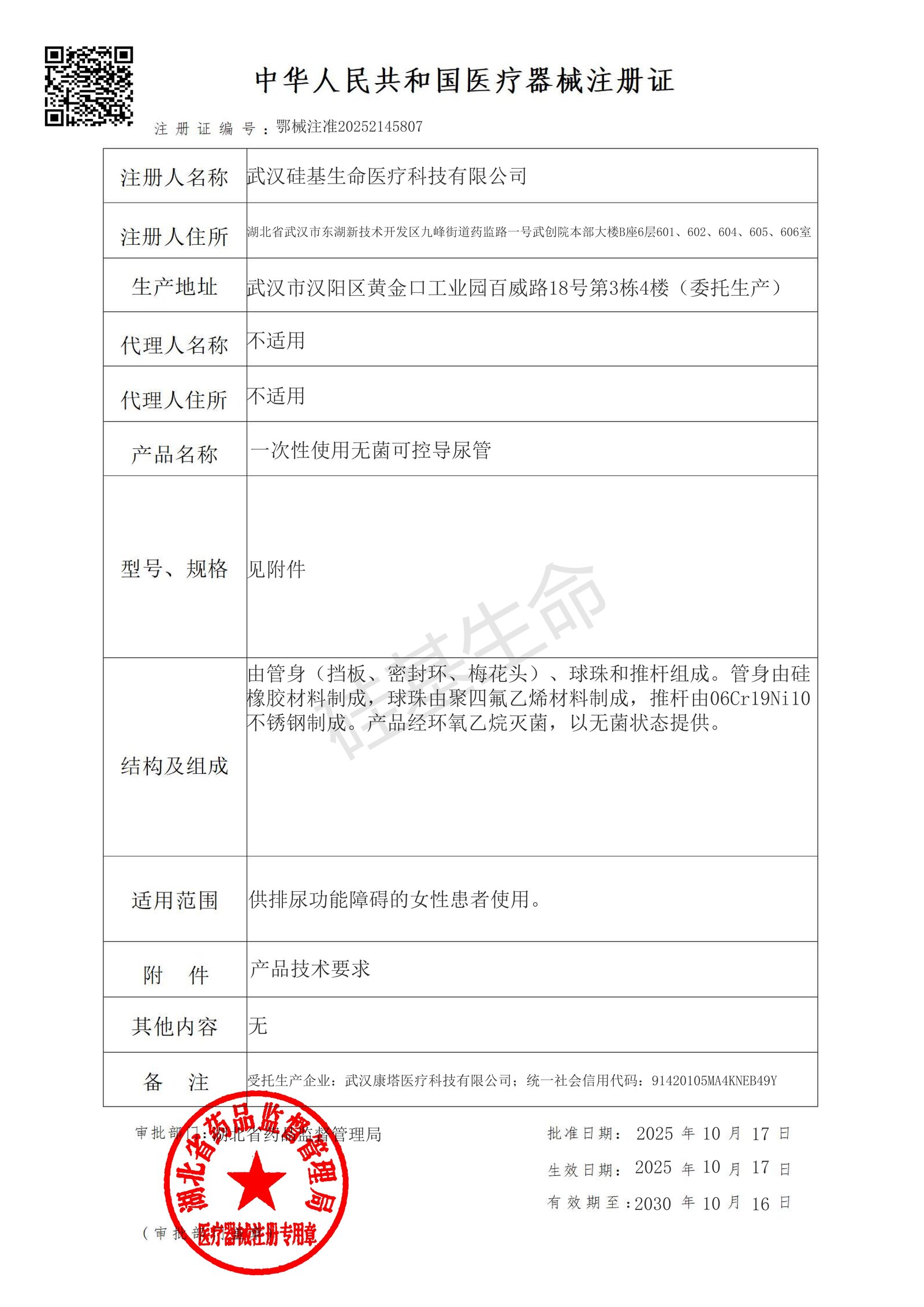
Medical device registration certificate
- Authority
- Hubei Medical Products Administration (NMPA framework)
- Country
- People’s Republic of China
- Device class
- Class II
- Registrant
- Wuhan Guiji Shengming Medical Technology Co., Ltd.
- Registration no.
- 鄂械注准20252145807
- Scope
- Female patients with voiding dysfunction
- Approved
- 17 October 2025
- Valid until
- 16 October 2030
This device is registered for the Chinese market only. It is not registered or approved for sale in any other market.
Study summary
A single-centre clinical study with a small sample and no control group. Results should be read with this in mind.
Request the full study report→- Design
- Interventional, single-centre, single-arm
- Enrolled / completed
- 23 / 19 participants
- Duration
- One catheter per participant for 30 days
Women unable to void voluntarily (detrusor underactivity, detrusor–sphincter dyssynergia, central nervous system injury, stress incontinence or post-stroke voiding dysfunction)
Convenience and comfort of placement, voiding and indwelling (combined score ≥ 4)
Serious adverse events and adverse events
In the per-protocol set, 18 of 19 participants (94.7%; 95% CI 74.0–99.9%) reached the convenience and comfort threshold, against a prespecified target of 70% (p = 0.0186).
No adverse events occurred among the 19 participants who completed the study. Four participants withdrew after the catheter dislodged or was removed because of discomfort; all four events were moderate and non-serious and resolved without sequelae. The investigators attributed them to a mismatch between patient anatomy and the two catheter sizes used in the study.
Small, single-centre study without a control group. Only two models (6.5 mm shaft; 35 and 45 mm length) were studied, which led the investigators to recommend a wider size range.
Documents and media
- MP4Download↓Operation videoEnglish captions · MP4 · 0:50
- JPGDownload↓Registration certificateChinese · JPG
- DOCRequest accessInstructions for UseFor healthcare professionals · on request
- DOCRequest accessClinical study reportFor healthcare professionals · on request
The Instructions for Use and the clinical study report are provided to healthcare professionals on request.