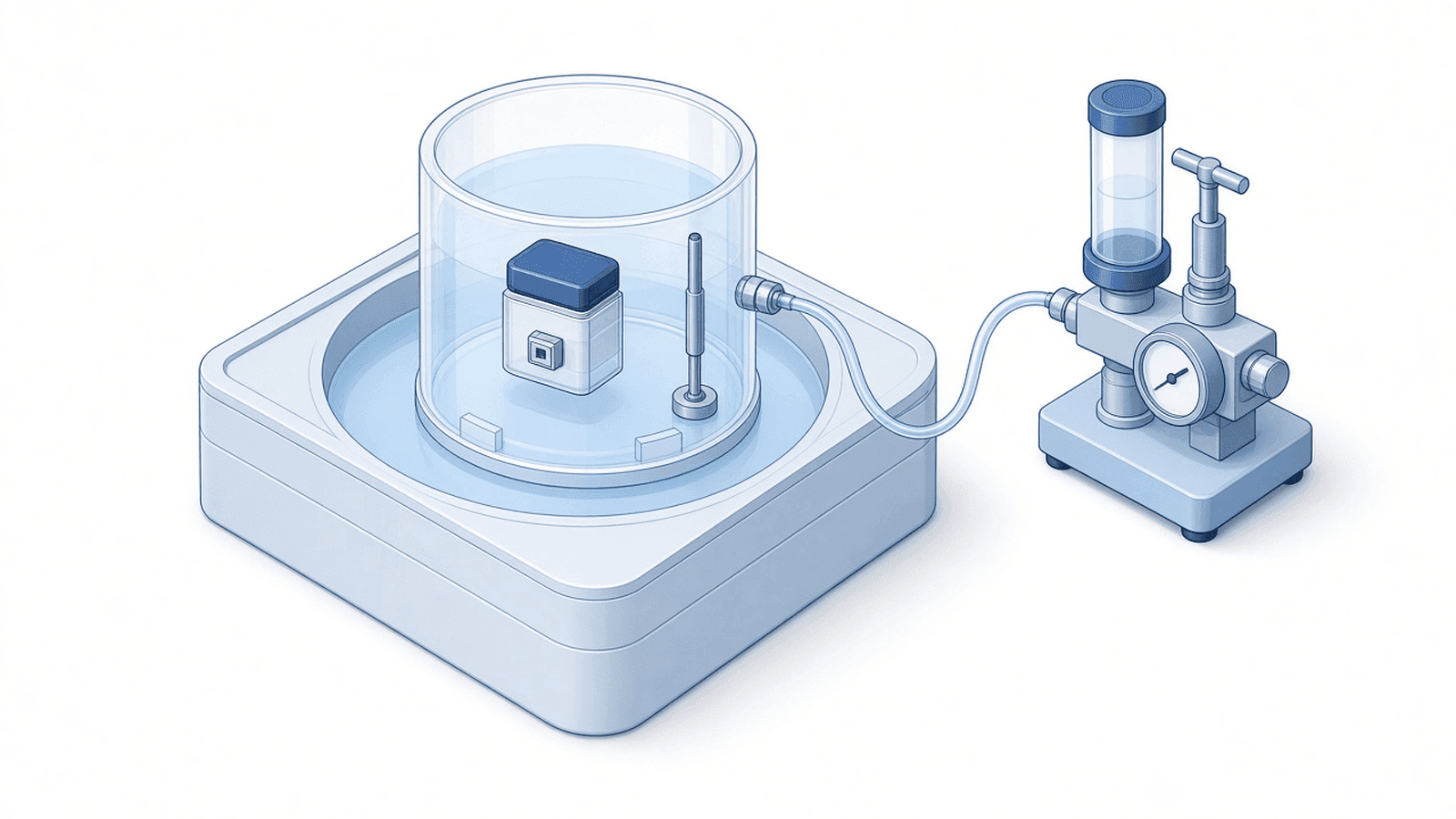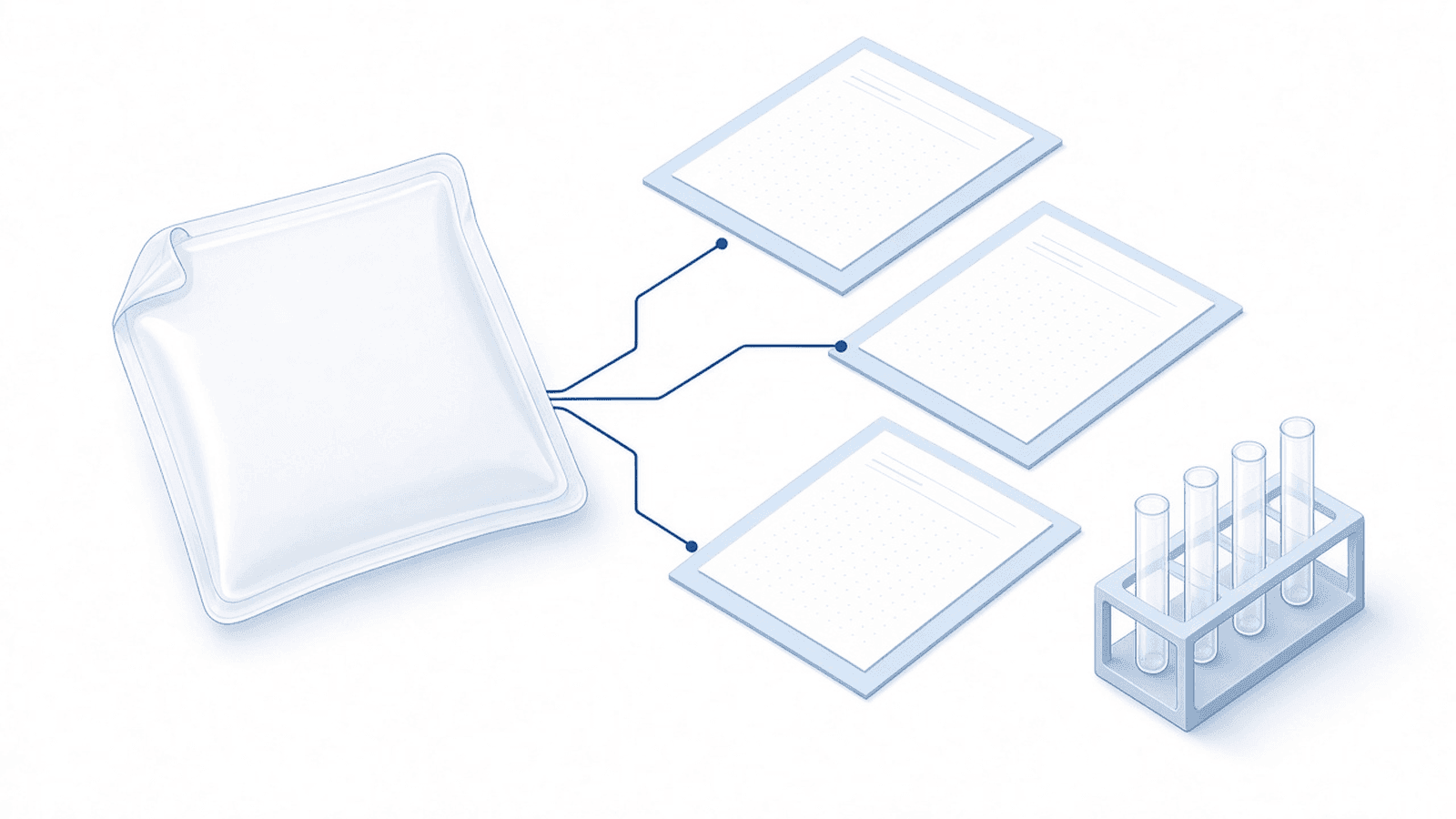

A supplier quotes a catheter with a hydrophilic coating and a hydration sachet. Its extractables summary names the product family and says the toxicological assessment found no concern. Before relying on that conclusion, ask three questions. Did the tested specimen include the quoted coating and the relevant sachet exposure? What did the extraction and analytical methods cover? Which dated toxicological assessment used those findings? If any answer is missing, use the traceability worksheet to write a specific follow-up request.
Use this guide alongside the hospital catheter RFQ checklist and the review of catheter materials and coatings.
What do extractables and leachables reports measure?
ISO 10993-18:2020, including Amendment 1:2022, describes a stepwise approach that can use one or more kinds of chemical information. A composition record identifies the materials and their constituents. Process information helps identify what manufacture may add, such as a mold-release agent or sterilization residue. An extractables study estimates what the device could release under defined laboratory conditions. A leachables study measures release under use conditions, or under simulated conditions with a justified link to use.24
A toxicological risk assessment (TRA) uses relevant chemical information to judge whether estimated exposures to constituents are negligible or tolerable. The scope of ISO 10993-17:2023 describes how chemical characterization can inform that judgment.8 The wider biological evaluation also considers factors such as device geometry and surface properties.1
Record the standard edition and amendment that the supplier actually used. FDA lists ISO 10993-18:2020 including Amendment 1:2022 (recognition 2-298) and ISO 10993-17:2023 (recognition 2-303) as partially recognized in the United States. Each entry specifies exclusions.28 A standard citation identifies the framework. The report still needs to show the method used and the scope of its results.
| Document or study step | What it evaluates | What a reviewer can credit from it | What remains unverified without further evidence |
|---|---|---|---|
| 1. Material declaration or resin certificate | Incoming base polymers, alloys or raw-material formulations prior to device manufacture12 | Identity and stated specifications of the named incoming material lot | Additives, adhesives, coatings, cleaning agents, molding thermal effects and sterilization residuals in the finished catheter13 |
| 2. Manufacturing and sterilization residue check | Substances introduced during forming, washing, assembly, coating or sterilization (for example, mold-release agents or EtO)23 | Control of targeted process aids or sterilization residuals within stated test scope | Unintended extractables from bulk polymers, dyes, packaging interactions or unmonitored process steps13 |
| 3. Laboratory extractables study | Potential chemical release under documented laboratory extraction conditions24 | Reported findings, including the confidence of identifications and the basis for quantitative estimates | Actual clinical release rates under use conditions, and whether the exposure poses an acceptable biological risk28 |
| 4. Simulated-use or leachables study | Chemicals migrating from the device into clinically representative fluids under simulated or actual use conditions12 | Measured migration profile for the tested fluid, temperature, duration and device configuration | Migration into other tissue environments or durations if the simulated vehicle or timing differs from intended use3 |
| 5. Toxicological risk assessment (TRA) | Whether estimated patient exposure to identified constituents is negligible or tolerable relative to toxicological thresholds18 | Dose-based exposure evaluation for the documented chemical inputs and exposure assumptions | Reliability of conclusions if underlying extraction conditions, solvent coverage or analytical sensitivity are inadequate7 |
Source: Adapted from ISO 10993-18:2020+Amd 1:2022 and ISO 10993-17:2023 public scopes on FDA Recognized Consensus Standards (references 2 and 8) and FDA final ISO 10993-1 guidance (reference 1).
Which catheter configuration was actually tested?
Start with the model on the quote and the revision on the report. FDA’s final guidance recommends using the device in the condition in which it will be used when biocompatibility testing is warranted. A representative test article may be appropriate with a documented rationale.1
Check these four details when comparing a catheter on the quote with the one in the report.
- Coatings, adhesives and surface treatments. Ask which patient-contacting surfaces received the coating or finish and which manufacturing aids were used. FDA’s final guidance illustrates how a resin supplier change can introduce residual processing solvents even when the base polymer has the same name.13
- Co-packaged fluids and accessories. Map the parts and fluids with a plausible route to direct or indirect patient exposure. A separate sachet and a catheter stored in hydration fluid present different questions about what can reach the coated surface.56 Where components have different contact durations, ask how the test plan represented each exposure and how any pooling was justified.14
- Preparation and shelf life. Ask whether the tested specimen reflected relevant preparation described in the instructions for use. For a catheter stored in fluid, ask whether the report considered changes to the device or migration from the pouch over the labeled shelf life and whether aged specimens were used where relevant.34
- Intended contact. Record where contact occurs, how long it lasts and whether exposure recurs. For example, FDA’s guidance for its conventional Foley pathway treats the covered devices as prolonged-contact devices and excludes designs such as lubricity-enhanced, antimicrobial and suprapubic catheters.9 Use the contact rationale for the quoted device when assessing the report.
How can a family representative or coupon cover the offered model?
One test article may support several sizes or variants when it represents the relevant chemistry and contact conditions. Existing data can also inform a risk-based evaluation. For a family report, ask which catalogue numbers the documented rationale covers.13
Section V.A and Attachment F of FDA’s final guidance compare representative specimens with the finished device by manufacturing and sterilization, chemical and physical properties, surfaces and the relative amounts of component materials. When those differ, ask for the evidence explaining how the difference could affect the study findings. Depending on the difference, supporting evidence can include a comparison of surfaces, constituent profiles or rates of release.1
Three practical checks distinguish a well-justified family or coupon bridge from an unsupported assumption:
- Surface area by material. FDA’s extraction slides advise considering the configuration with the largest surface area of each relevant material. The largest French size may still have a different coating area, length or component mix from another model. FDA’s draft chemical-analysis guidance cautions against simply scaling results from a smaller device.34
- Cut surfaces. Cutting tubing can expose edges and core materials absent from the surfaces that patients contact in use. Ask what was cut, which new surfaces were exposed and whether this affected the interpretation.34
- Limits on coupons: Coupons are easier to defend for homogeneous materials or non-permeable metals than for multi-material, coated or assembled catheters where joint adhesives, valve housings or lumen interiors contribute differently to total surface area.3
Which extraction and reporting details change the interpretation?
Even when the tested article matches the quoted catheter, extraction design and analytical reporting govern what the study can detect. A reviewer does not need to recalculate chromatograms to check four high-leverage method fields.
Extraction purpose, solvent polarity and material compatibility
Read the study objective alongside the contact duration. FDA’s 2026 extraction slides describe exaggerated extraction for limited contact, exaggerated or exhaustive extraction for prolonged contact, and exhaustive extraction for long-term contact. Exaggerated conditions intensify the exposure relative to clinical use. Exhaustive extraction uses repeated cycles to approach a defined endpoint. If a report calls a series exhaustive, check whether the cycle durations were consistent and whether the endpoint and measurement basis were documented.3
Ask which solvent polarities were covered and how the lab checked compatibility with the device. Some solvents can irreversibly damage the sample or expose normally sealed surfaces. The FDA slides also caution that alcohol–water mixtures can behave unpredictably in worst-case screening.3 In a different kind of study, Wang and colleagues at Abbott Vascular used an ethanol–water mixture as a blood surrogate for a vascular catheter. The study illustrates how the proposed use of a solvent depends on the question being asked. A urinary study needs a rationale for its own test fluid.11
Replicates, particulates and analytical sensitivity
FDA’s extraction town hall used a sample of 19 premarket letters from fiscal year 2025 that contained 32 deficiencies involving chemical characterization or toxicological risk assessment. The slides list issues such as unclear sample preparation, extract handling and inadequate analytical sensitivity.3 The selected letters illustrate review questions. They offer no estimate of how often those problems occur across submissions or suppliers.
- Extraction and analytical replicates. Multiple injections of one extract show instrument repeatability. Separate extractions can capture variation across specimens or preparation. If the report claims lot-to-lot coverage, look for the actual lot identifiers and sampling plan.34
- Extract handling and particulates. Ask whether the lab filtered, pooled, concentrated or otherwise changed the extract and what effect that had. FDA’s guidance recommends documenting the condition of the extract and justifying additional processing. Its extraction slides also explain why the lab should distinguish debris from material that precipitated out of the extract.13
- Sensitivity and identification confidence. The analytical evaluation threshold (AET) helps define which signals the study should report or investigate. The limit of quantification (LOQ) describes the method’s ability to quantify a substance reliably. Ask whether the methods were sensitive enough for the applicable reporting threshold and how the lab handled uncertain identifications. FDA’s 2024 draft, marked not for implementation, explains these distinctions and discusses separate consideration of high-potency compounds.4
What do public urinary-catheter records disclose about the test?
Examining real public regulatory documents shows both how diverse urinary-catheter configurations are and how much method detail public summaries leave out. Comparing two FDA-hosted 510(k) intermittent-catheter summaries, one combination-product FDA biocompatibility consult memo and one implantable-system PMA summary illustrates what a hospital buyer can—and cannot—read directly from public records.
| Public record | Device and configuration disclosed | Chemical characterization & sterilization disclosure | What remains unverified from the public record |
|---|---|---|---|
| Well Lead K220722 510(k) Summary (2023)5 | PVC intermittent urethral catheter with polyacrylamide hydrophilic coating and optional separate water sachet | Section 6 lists ISO 10993-18:2020. Section 7 describes irradiation of the water sachet before assembly and terminal ethylene oxide sterilization of the finished product. | Which catheter sizes, coating variants or sachet assemblies were extracted, solvent set, AET/LOQ values, detected analytes and TRA linkage |
| Hollister K211436 510(k) Summary (2022)6 | Thermoplastic elastomer intermittent catheter with a hydrophilic PVP-based coating and hydration fluid in the same foil pouch | The nonclinical section lists ISO 10993-18:2020 and ISO 10993-17:2002. The comparison table specifies electron-beam sterilization for this catheter. | Whether aged hydrated pouches were extracted, fluid contribution vs. catheter shaft contribution, analytical methods and chemical findings |
| FDA review of NDA 219683 (TAR-200, 2025)7 | Urinary Placement Catheter (shaft and stylet) for brief placement of a bladder drug-device system | The initial biocompatibility consult describes two chemistry studies for the placement catheter and an exposure assessment. The integrated review records how the questions about specimen identity and solvent coverage were resolved. | The study table redacts details such as extraction times and reporting thresholds. The findings apply to the placement catheter and its use conditions. |
| FDA P230044 alfapump SSED (2024)10 | Implantable ascites pump system with separate Bladder Catheter and Peritoneal Catheter SNCA-5262L | Nonclinical testing table (pp. 35–36) assigns separate ISO 10993-18:2020 / Amd 1:2022 chemical-characterization rows (“Passed”) to each catheter component | The public table gives the purpose and reported result. It leaves the specimen count, extraction setup and analytical findings undisclosed. |
Source: Adapted from the named applicant 510(k) summaries and FDA reviews (references 5–7 and 10).
The TAR-200 record shows what a documented explanation can accomplish. FDA initially asked whether biological tests naming the “TARIS Inserter” applied to the final Urinary Placement Catheter. The integrated review accepted the supplier’s comparison, which identified a change in the dimensions of a stylet hub that does not contact the patient. In a separate chemistry question, the initial toxicological assessment covered polar and mid-polar extracts. The sponsor could not identify a compatible non-polar solvent. FDA accepted the additional material characterization, solvent-compatibility rationale and short, infrequent exposure as sufficient to assess acute systemic toxicity for that catheter. Ask for the same kind of reasoning about the offered model and intended exposure when a supplier leaves part of the analytical scope open.7
A traceability worksheet for reviewing the supplier’s report
Use one row set per quoted model or documented product family. Record the report ID and page or section for each answer. Keep a missing detail open until the reviewer receives an explanation or decides that other evidence addresses the same question.
| Traceability field | What the reviewer records | What the record helps establish |
|---|---|---|
| 1. Offered configuration and label revision | Exact quoted catalogue number(s), sizes, coatings, kit accessories, IFU/label revision and target market | Anchors the review to the exact product being bought rather than a generic family brochure |
| 2. Components, body contact and duration | Direct and indirect contact routes, relevant parts or fluids, duration per use and frequency of repeat exposure | Prevents prolonged-contact components from being masked by limited-contact accessories or pooled dilutions1 |
| 3. Test article identity, finish and sampling | Tested SKU/lot, whole device vs. coupon/cut segment, sample count, extraction replicates and written bridging rationale for untested variants | Shows which geometry, contact surfaces and sampled lots the results represent |
| 4. Processing, coating, assembly and sterilization state | Processing and final sterilization of each relevant component, packaging or fluid contact, and whether the sample reflects aging and preparation where relevant | Resin changes, coatings, packaging migration and terminal sterilization can each alter extractables13 |
| 5. Extraction objective, solvents and conditions | Exaggerated vs. exhaustive vs. simulated-use objective; solvent polarities; temperature, cycle duration, vessel, surface-to-volume ratio and swelling/particulate notes | Determines whether aggressive screening or clinically simulated release was tested and whether solvents covered lipophilic and polar migrants37 |
| 6. Analytical coverage, reporting basis and uncertainty | Instrument families (for example, GC-MS, LC-MS, ICP-MS), AET/LOQ basis, surrogate/authentic standards and identification confidence | Defines what could be detected and keeps non-detect claims bounded by method sensitivity34 |
| 7. Linked exposure and TRA scope | TRA document ID and revision, linked chemistry report, use frequency, contact duration, other exposure assumptions and treatment of unknown findings or gaps | Confirms chemistry findings actually feed an up-to-date toxicological risk evaluation78 |
| 8. Gap, disposition, owner and source reference | Remaining open questions, disposition label, named reviewer (supplier quality / toxicologist / procurement) and date | Ensures confidential or missing fields remain tracked rather than treated as an unqualified pass |
Source: Editorial synthesis anchored to FDA final ISO 10993-1 guidance Sections V.A, VII and Attachments E–F (reference 1), FDA CDRH September 2026 extraction slides (reference 3) and ISO 10993-18 / 10993-17 scopes (references 2 and 8).
Three hypothetical review dispositions
The three fictional cases below illustrate how a hospital committee can classify incomplete or bridged files fairly without inventing chemical limits or penalizing normal supplier confidentiality.
| Fictional tender scenario | What the file establishes | What remains unverified | Recommended reviewer action |
|---|---|---|---|
| Case A. A coated family report and linked TRA name the tested size. A signed comparison maps the quoted models to the same coating, materials, processing and sterilization and shows how the specimen covers the relevant surface areas. | Documented representative coverage across materials, processing, contact surfaces and linked exposure evaluation | Whether the linked exposure assessment covers the use frequency and contact duration of the quoted models | Record the supported configuration match and confirm the exposure assumptions with the qualified reviewer before closing the item. |
| Case B: Quoted catheter has a hydrophilic coating and terminal EO sterilization, but the file contains a base-resin certificate of analysis plus an extractables report on an uncoated pre-sterilization coupon | Base polymer composition identity and screening data for the uncoated coupon under its stated extraction conditions | Chemical contribution of the hydrophilic coating, curing aids, EO residuals, cut-coupon edge effects and finished-device exposure | Record the resin identity and keep the finished-device chemistry open. Request a scoped finished-catheter assessment or evidence that bridges the coupon to the offered configuration. |
| Case C: Redacted summary correctly names the final quoted SKU and cites ISO 10993-18:2020, but withholds solvents, extraction ratio, AET and TRA document linkage under confidentiality | Documented claim that a chemistry assessment exists for the exact offered model | Solvent polarity coverage, exhaustive/exaggerated conditions, reporting threshold and link to toxicological exposure conclusions | Record the named model and request a signed scope table or a controlled review under a confidentiality agreement. Leave the method and assessment link open. |
Source: Editorial illustration based on FDA final guidance Section V.A / Attachment F (reference 1) and NDA 219683 review logic (reference 7). No real supplier or test values represented.
What should the buyer ask for when the link to exposure is missing?
When a summary stops at “passed chemical characterization” without connecting the extracted data to patient exposure, send targeted clarification questions rather than asking for raw laboratory files indiscriminately:
- Test article and revision. Which catalogue numbers, manufacturing site, coating, accessories and sterilization state did the specimen represent? What evidence covers each quoted variant?
- Extraction and solvent coverage. What was the objective of the extraction? If the lab omitted a solvent class for compatibility reasons, what other evidence addresses the resulting gap?
- Analytical coverage. Which chemical classes were in scope and what detection, quantification and reporting limits applied?
- Link to patient exposure. Which dated TRA used the reported findings, which exposure assumptions did it use and how did it handle uncertain identifications?
- Changes since testing. Has the supplier changed a resin, coating, process aid, packaging film or sterilization procedure since the report was signed?
Where Silicon Life fits
Silicon Life’s Disposable Sterile Controlled Catheter is a Class II device registered in China only (鄂械注准20252145807) for female patients with voiding dysfunction. The public product page describes its materials and ethylene oxide sterilization.12
For a chemistry review, the product page identifies the configuration and registered indication to match against the test report.12 Teams evaluating the China-registered device for that indication can request its Instructions for Use or supporting technical documentation.
Frequently asked questions
Does a raw-material certificate cover a finished coated catheter?
A certificate documents the incoming material lot. For the finished catheter, ask how the evaluation accounts for relevant manufacturing aids, coatings, packaging contact and sterilization. When evidence comes from a representative specimen, ask for the written comparison to the finished model.12
Can a representative sample support several catheter sizes or kit variants?
Yes, if the rationale covers each quoted configuration. For a kit, ask which components and exposure routes the study represented and how the report accounts for differences in contact duration, composition or exposed surface area.134
Can I read a non-detect as evidence the device releases nothing?
Read a non-detect in the context of the substance, method and detection limit. A signal below the LOQ may still be detectable without being reliably quantified. A substance can also fall outside the report’s scope because the selected solvent or instrument offers limited coverage. Ask how the lab defines and reports each case.347
Are a sterilization residual result, an endotoxin result, and an extractables report interchangeable?
Ethylene oxide residual testing addresses specified sterilization residues. Bacterial endotoxin testing addresses endotoxins from Gram-negative bacteria. Chemical characterization examines substances from the device or its processing within the stated scope of the method.23
What can the reviewer do with a redacted or summary-only chemistry report?
Separate identity confirmation from confidential technical detail. Even in a summary or redacted file, the supplier should identify the exact tested SKU/family bridge, contact scope, extraction objective, solvent classes, analytical platforms and dated TRA linkage.17 If proprietary compound names or quantities are withheld, record what is visible and request a signed scope table or controlled NDA review rather than treating confidentiality as proof of non-testing.
Source review on November 24, 2026. FDA guidance, recognized-standard records and public dossiers are used here as US examples. The September 2024 chemical-analysis guidance remains a draft, and the September 2026 town-hall slides explain review considerations.34 The public summaries disclose selected details. The worksheet and fictional cases support procurement review alongside local quality procedures and qualified toxicological judgment.
References
- 1US Food and Drug Administration. Use of International Standard ISO 10993-1, “Biological evaluation of medical devices – Part 1: Evaluation and testing within a risk management process”. Guidance for Industry and Food and Drug Administration Staff, September 2023 (with QMSR cover note). Sections III.A–C, V.A, V.E–F, VII and Attachments E–F.
- 2US Food and Drug Administration. Recognized Consensus Standards: ISO 10993-18 Second edition 2020-01 [Including AMD1:2022], FR Recognition List 067, Recognition Number 2-298 (entry date September 7, 2026; partial recognition and Scope/Abstract).
- 3US Food and Drug Administration, Center for Devices and Radiological Health. Biocompatibility Town Hall #2: Extractions for Conducting Chemical Analysis for Biocompatibility Assessment. Presentation slides, September 23, 2026.
- 4US Food and Drug Administration. Chemical Analysis for Biocompatibility Assessment of Medical Devices. Draft Guidance for Industry and Food and Drug Administration Staff, September 2024 (Not for implementation). Sections V–VI and Appendix A. · Draft guidance PDF
- 5Well Lead Medical Co., Ltd. Wellead PVC Hydrophilic Urethral Catheter, 510(k) Summary K220722 (FDA-hosted, summary prepared May 16, 2023; cleared May 22, 2023). Sections 4, 6 and 7, pp. 1–7.
- 6Hollister Incorporated. Intermittent Catheter, 510(k) Summary K211436 (FDA-hosted, summary prepared January 25, 2022; cleared January 27, 2022). Pp. 1–4.
- 7US Food and Drug Administration. NDA 219683 (TAR-200 Gemcitabine Intravesical System and Urinary Placement Catheter). CDRH review, Reference ID 5656029, Section VII, pp. 14–26, and biocompatibility consultation, Reference ID 5656036, pp. 16–20 (2025).
- 8US Food and Drug Administration. Recognized Consensus Standards: ISO 10993-17 Second edition 2023-09 (Toxicological risk assessment of medical device constituents), FR Recognition List 061, Recognition Number 2-303 (entry date December 18, 2023; partial recognition and Scope/Abstract).
- 9US Food and Drug Administration. Conventional Foley Catheters — Performance Criteria for Safety and Performance Based Pathway. Guidance for Industry and Food and Drug Administration Staff, August 14, 2020. Sections I–II and Section III (Biocompatibility Evaluation).
- 10US Food and Drug Administration. alfapump System (P230044) Summary of Safety and Effectiveness Data (FDA-hosted, 2024). Nonclinical testing summary table for Peritoneal Catheter SNCA-5262L and Bladder Catheter, pp. 30–36.
- 11Wang H, Yu H, Tran TN, et al. Chemical Characterization of Leachables in Catheter Device. ACS Omega. 2022;7(51):48291–48300 (PubMed author abstract and affiliations, PMID 36591149).
- 12Silicon Life. Disposable Sterile Controlled Catheter: product page, specifications, materials and China registration statement.
Silicon Life. Does the Extractables Report Cover the Urinary Catheter You’re Buying?. SILICON·LIFE Insights. 24 November 2026.

Silicon Life develops urological devices and implantable systems in Wuhan, China. Its Insights are written for healthcare professionals, with the sources for each article listed in full.
This article is provided for educational purposes for healthcare professionals. It does not constitute medical advice and does not replace the Instructions for Use of any device. Product availability and indications differ by country.
New articles on urology devices and implant engineering.
Clinical reviews, engineering notes and company news from Silicon Life, sent when new articles are published.
Occasional emails. Unsubscribe at any time.