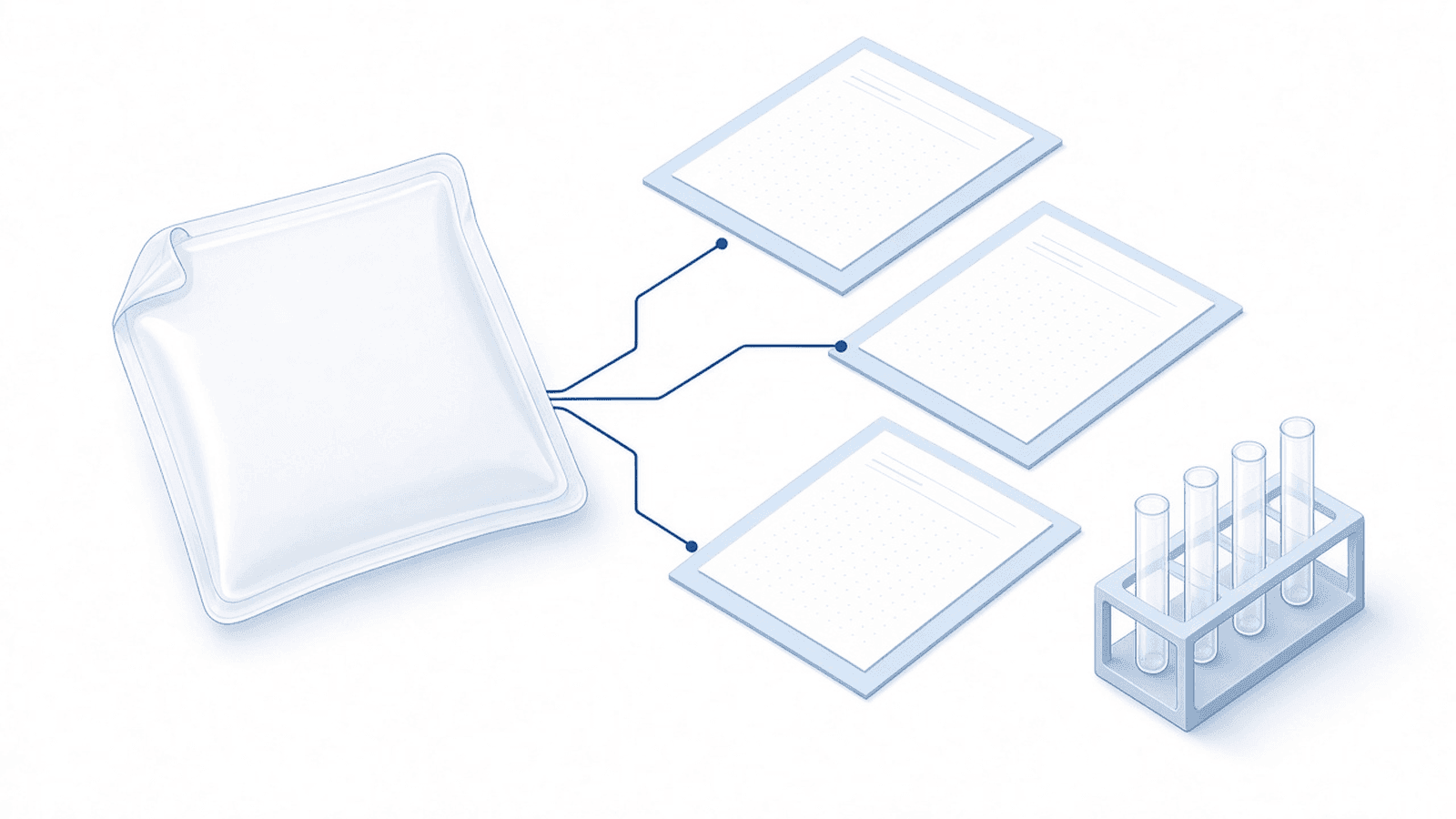
A tender file for a sterile urinary catheter often contains several different kinds of statement: “sterile”, “single use”, “latex-free”, and sometimes “non-pyrogenic” or a figure in endotoxin units. They are easy to read as one bundle of reassurance. They are not. Each one answers a different question and needs its own evidence. This guide covers the endotoxin and pyrogen part of that bundle: what the claim actually asserts, what evidence would support it for the exact catheter being offered, and how to record a gap fairly when the file does not close it.
It sits beside our earlier guide to sterile catheter packaging evidence, which deals with sterile-barrier integrity and deliberately leaves pyrogen claims aside. It also complements the broader catheter procurement evidence request, which lists the evidence areas to cover before a hospital pilot.
Which claim is being made: sterile, an endotoxin result or non-pyrogenic?
Sterile concerns viable microorganisms. In US premarket submissions, FDA asks sponsors of devices labeled sterile to state a sterility assurance level (SAL) of 10−6, meaning a one-in-a-million probability of a surviving microorganism, unless the device contacts only intact skin.2 A sterilization record supports that statement. It does not measure what killed bacteria leave behind.
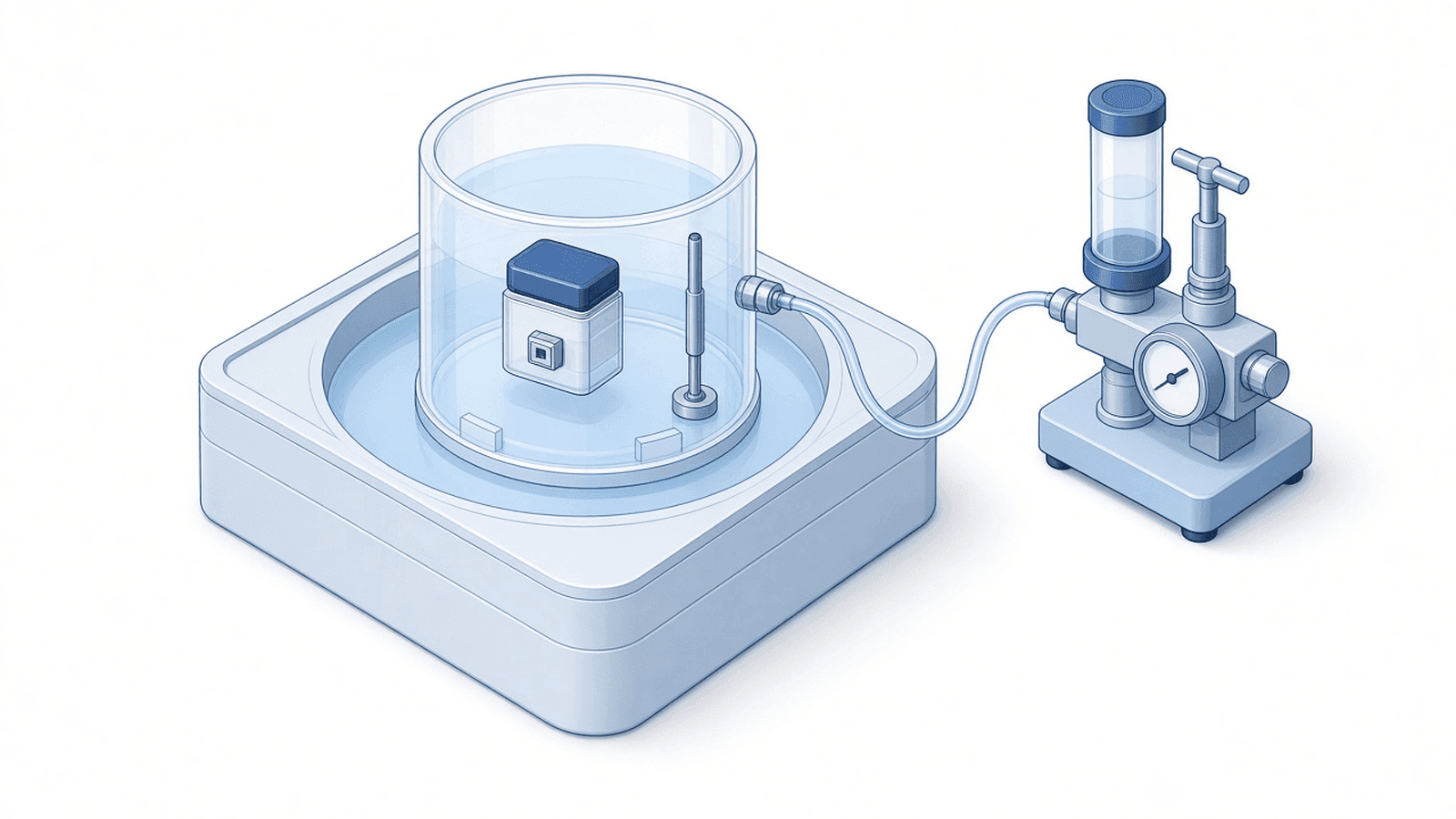
Bacterial endotoxins are fever-causing substances from the outer membrane of Gram-negative bacteria.2 The FDA technical guide explains that endotoxins come from high microbial loads and are not removed by sterilizing filters. Bringing a high microbial count down therefore does not bring a high endotoxin level down with it.7 The same guide names water used to wash or rinse tubing and other plastic components before sterilization as a possible source.7 A bacterial endotoxins test (BET) measures this one family of pyrogens.
Non-pyrogenic is a broader label claim. FDA’s 2024 sterility guidance says pyrogenicity testing protects patients against fever caused by bacterial endotoxins or by other pyrogens, such as material-mediated pyrogens: chemicals that can leach from a device and are usually assessed as part of the biocompatibility evaluation.2 The same guidance recommends “non-pyrogenic” or “meets pyrogen limit specifications” rather than “pyrogen free” unless complete removal of pyrogens can be shown.2
| Statement in the file | What it asserts | Evidence that addresses it | What it does not establish |
|---|---|---|---|
| “Sterile” (with sterilization method) | No viable microorganisms to the stated SAL | Sterilization validation summary, SAL, sterile-barrier evidence | Endotoxin level or absence of other pyrogens |
| Bioburden record | Number of microorganisms on product before sterilization | Bioburden test summary for the product family | An endotoxin result. Bioburden counts organisms, not their residues |
| Endotoxin result (e.g. “< x EU/device”) | Measured endotoxin activity in a device extract | Report naming the test article, extraction, method, sampling and limit | Material-mediated pyrogenicity. A result for one configuration says nothing about another |
| “Non-pyrogenic” / “meets pyrogen limit specifications” | The device meets a pyrogen limit specification | Endotoxin evidence. If the device would not otherwise need to meet pyrogen limits, evidence on material-mediated pyrogens as well2 | Clinical infection outcomes, or comparative safety against other catheters |
| “Pyrogen free” | Complete absence of pyrogens | The basis for claiming complete removal, which FDA treats as the exception2 | Usually more than the evidence supports. Ask why this wording was chosen |
| Raw-material certificate | Properties of an incoming material lot | Supplier certificate of analysis | Contamination picked up during later washing, assembly, packaging or sterilization |
Which contact scope and catheter configuration does the evidence cover?
The 2026 FDA Q&A says endotoxin limits for a medical device depend on its intended use and on what it contacts. Its examples are blood, the cardiovascular system, cerebrospinal fluid, intrathecal routes, permanent implants and subcutaneous implants.1 For extracts prepared as FDA recommends, it gives 0.5 EU/mL or 20 EU/device for products that directly or indirectly contact the cardiovascular or lymphatic system, and 0.06 EU/mL or 2.15 EU/device for devices in contact with cerebrospinal fluid.1 The public introduction to USP chapter <161> covers devices labeled sterile and nonpyrogenic that contact the cardiovascular system, lymphatic system or cerebrospinal fluid. Its examples are mostly infusion, transfusion, dialysis and implant pathways.4
A urethral catheter is not an obvious fit for those examples, and the documents do not hand a reviewer a single urinary-catheter answer. Under FDA’s 2024 sterility guidance, three groups of devices should meet pyrogen limit specifications: implants; devices in direct or indirect contact with the cardiovascular system, lymphatic system or cerebrospinal fluid; and devices labeled non-pyrogenic.2 Two questions follow for an indwelling catheter:
- Is a long-dwell catheter treated as an implant? For device classification, US regulation defines an implant as a device placed in a surgically or naturally formed body cavity and intended to remain there continuously for 30 days or more.9 The sterility guidance does not say whether that definition governs its own “implants” category. For a catheter labeled for multi-week dwell, ask the supplier how it classified the contact and why. Do not assume the answer.
- Is the catheter labeled non-pyrogenic? If so, the label itself puts the device in scope. FDA adds that where a device would not need to meet pyrogen limits because of its body contact but is labeled non-pyrogenic anyway, both bacterial endotoxin and material-mediated pyrogenicity testing are recommended.2 An endotoxin result alone would then leave half of that claim unaddressed.
Configuration matters just as much. A catheter offered as a kit with a drainage bag, valve or pre-filled syringe has several patient-contacting or fluid-path parts. A report on the bare catheter shaft does not automatically cover a different size range, a coated variant or an accessory supplied in the same pouch. Our material and coating claim appraisal explains why substrate and coating differences matter for other claims as well.
A claim-to-evidence worksheet for one offered catheter
The worksheet below is a Silicon Life editorial proposal for keeping one claim tied to its evidence. Use one row per claim, per offered configuration. It does not tell a laboratory how to run an assay, and it does not set acceptance limits. Those decisions belong to the manufacturer, its regulator and the hospital’s qualified quality reviewer. Its job is to make the review traceable and to keep unresolved items visible. The field anchors come from FDA’s description of the pyrogen information it expects in a sterile-device submission: method, batch testing or sampling plan, chosen limit and the rationale for that limit.2
| Field | What to record | Why it matters |
|---|---|---|
| 1. Exact claim and label version | The wording as printed (“non-pyrogenic”, “< x EU/device”, “pyrogen free”), the IFU or label revision, and the market it applies to | Wording determines what must be supported. A claim on one market’s label may not appear on another’s |
| 2. Offered model and contact scope | Catalogue numbers, sizes, coatings, kit contents. The intended dwell and body contact the supplier assigned | Limits depend on intended use and contact.1 A rationale for one configuration does not transfer to another |
| 3. Document identity | Report or summary ID, revision, date, issuing laboratory or function, and whether it is a full report, summary or declaration | Lets the hospital tell a test report from a marketing statement, and trace later revisions |
| 4. Test article and representativeness | Was the finished, sterilized device tested? Which sizes or variants represent the family, and why? | Contamination can enter during washing and processing before sterilization.7 Testing a raw material or a different variant may miss it |
| 5. Method identity and suitability | Method family (e.g. gel-clot, kinetic, recombinant-reagent BET, rabbit test, monocyte activation), and evidence that it suits this device extract | Alternative and recombinant methods are accommodated, but suitability for the specific product must be verified.13 |
| 6. Result, units and limit rationale | Reported value with units (EU/mL or EU/device), the limit applied, and the stated reason that limit fits the contact | A number without its limit and rationale cannot be interpreted. A borrowed blood-contact limit needs justification |
| 7. Sampling or release scope | Every-batch testing or a sampling plan. Validation only, or ongoing lot release | FDA asks for either confirmation of every-batch testing or the sampling plan.2 A single validation run does not describe the lots that will ship |
| 8. Material-mediated pyrogens | Where a non-pyrogenic claim is made, how non-endotoxin pyrogens were assessed (biocompatibility evaluation or pyrogen test) | Endotoxin assays detect only one class of pyrogen.12 |
| 9. Remaining gap, reviewer and disposition | What is still open, who reviewed it, the date, and the disposition (see below) | Keeps an unresolved item from disappearing once the scoring sheet closes |
Four dispositions that keep the record fair
- Supported within stated scope: the evidence names the offered configuration, method, limit rationale and release basis, and the reviewer accepts them for this purpose.
- Clarification requested: the claim is made, but a field is missing or ambiguous. Record the specific question sent to the supplier.
- Outside the scope of the supplied evidence: the evidence exists but covers a different variant, component, contact category or market label.
- Not claimed: the offer makes no endotoxin or pyrogen claim. Note this. Do not record it as a failure. Whether the hospital needs such a claim is a separate specification decision.
None of these dispositions says a product is unsafe or that testing never happened. Suppliers often share a controlled summary rather than a full laboratory report, under confidentiality. Record how much evidence you were able to see separately from whether it was adequate.
Three hypothetical document-review cases
The following cases are invented to show how the worksheet behaves. They describe no real supplier, product or test result.
Case 1: the file proves sterility and nothing more
An offer describes a catheter as “sterile, single use”. The dossier contains a sterilization summary and a packaging validation report. It makes no endotoxin or pyrogen claim. Record fields 1–3 for the sterile claim and mark the endotoxin row Not claimed. Do not mark it as a failure. If the hospital’s own specification requires a non-pyrogenic claim, that becomes a clarification question to the supplier. Neither the reviewer nor the supplier should infer a pyrogen result from the sterility documents. As the historical Foley investigation below shows, the two can differ.5
Case 2: a number without a test article
A one-page summary reports an endotoxin value in EU/device but does not say whether the tested item was the finished catheter, a component or a different size. It also does not say whether the reported unit refers to one device or a pooled extract. The value cannot be connected to field 4 or field 6. Mark it Clarification requested. Ask which configuration was tested and why it represents the offered family, and which limit was applied and why. Do not convert units, extrapolate to other sizes or supply a missing limit yourself.
Case 3: a changed assay method, backed by a reagent brochure
During a contract renewal, the supplier says it has moved from a lysate-based test to a recombinant-reagent endotoxin assay and attaches the reagent manufacturer’s validation brochure. FDA’s 2026 revision does accommodate recombinant reagents, but it adds that users should verify that the assay suits its intended purpose.3 The Q&A says a transition between endotoxin methods should compare the two methods, with limit of detection and inhibition/enhancement as the core comparisons. It also says device manufacturers should show a sensitivity consistent with the route and type of body contact.1 A generic brochure is not device-specific suitability evidence. Mark field 5 Clarification requested and ask a qualified reviewer to assess the supplier’s product-specific verification. The method change is neither a reason to reject the product nor a reason to accept it unexamined.
What a reviewer can reasonably ask about the method
Hospital reviewers do not need to re-run a laboratory method. A few questions taken from the FDA Q&A help separate a substantive summary from a thin one:
- Interference: endotoxin assays can be disturbed by the physical and chemical properties of the test article. FDA says firms should use the rabbit pyrogen test where interference cannot be overcome by dilution or other validated sample preparation.1 Ask whether inhibition/enhancement was checked for this device extract. FDA lists sampling fewer than three lots for inhibition/enhancement testing as a significant deviation.1
- Extraction: device extracts may be prepared by flushing, immersion or disassembly. FDA recommends a rinse approach and warns against extraction that dilutes endotoxin more than USP <85> allows.1 The summary should say how the extract was obtained. A reviewer can ask without prescribing a particular method.
- Non-endotoxin pyrogens: FDA expects device firms to assess the risk of non-endotoxin pyrogens and says a rabbit pyrogen test may be more appropriate if such pyrogens may be present.1 For a non-pyrogenic claim, ask how this risk was addressed.
- Pooling and sampling: FDA permits pooled extracts of finished devices for endotoxin testing and treats sampling as something to adjust as manufacturing experience builds.1 The 1985 technical guide records a case where a pooled sample was acceptable but individually tested units occasionally failed.7 The summary should therefore describe how samples were pooled and how lots were sampled, not just give one passing number.
These are prompts for discussion with the supplier and the hospital’s qualified quality staff, not acceptance criteria. Where a reviewer is unsure whether an answer is adequate, record the question and the response, and escalate. A reviewer should not improvise a pass/fail rule.
What historical and conference evidence can and cannot establish
The 1984 Foley catheter investigation. Gephart reported a 1980 investigation into a cluster of fevers after transurethral resection of the prostate. Prostatitis or urinary tract infection could not explain most cases, and antimicrobials did not prevent them. Unused, prepackaged, sterilized triple-lumen catheters from 13 lots were analyzed. Four contained high endotoxin levels, and those lots were highly pyrogenic in rabbits. The highest febrile incidence (42%) coincided with the lot with the highest endotoxin level.5 The case shows clearly that a sterile catheter can still be pyrogenic. It is also limited. It comes from a male surgical setting more than four decades ago, it is an association rather than a controlled comparison, and only the abstract was available for this review. It gives no current contamination rate and no ranking of materials or manufacturers.
The 1994 Foley guidance. FDA’s historical premarket guidance for Foley catheters asked that a device labeled pyrogen free or non-pyrogenic be accompanied by a description of the method used to make that determination (LAL or rabbit test).6 It predates FDA’s Good Guidance Practices, so current expectations come from the 2024 and 2026 documents above. It is still useful as a reminder that catheter pyrogen claims have long been expected to state their method.
A 2024 conference poster. An International Continence Society poster on a zwitterionic catheter surface treatment plotted endotoxin extracted from several commercial Foley catheters. Its reference line carries a footnote stating a limit of 20 EU/device “for blood contacting devices”.8 The footnote is a useful scope cue: the benchmark was explicitly a blood-contact figure, not a urinary-catheter limit. When a supplier or study quotes the same number, ask whether it is presented as a regulatory limit for the catheter or as a borrowed reference. The poster is developer-authored, early-stage work. We do not reproduce its product-level values or treat them as a current cross-vendor comparison. It also does not show that lower endotoxin levels reduce infections or complications.
Where Silicon Life fits
Silicon Life publishes this guide for hospital teams that review catheter documentation as well as clinical design. The Disposable Sterile Controlled Catheter is a Class II device registered in China only (registration no. 鄂械注准20252145807). It is indicated for female patients with voiding dysfunction and is not registered or approved in any other market. Its public product page lists it as supplied sterile for single use, with ethylene oxide sterilization.10 Neither that page nor this article makes an endotoxin or non-pyrogenic claim for the product. Nothing here should be read as one.
Healthcare professionals and distribution partners who need product documentation can request the Instructions for Use and supporting records. The same worksheet applies to our documentation as to anyone else’s.
Frequently asked questions
Does a sterile label establish that a catheter is endotoxin-free?
No. Sterility refers to viable microorganisms. Endotoxins can remain after bacteria are killed, and reducing a high microbial count does not reduce a high endotoxin level with it.75 An endotoxin or non-pyrogenic claim needs its own evidence. If the label makes no such claim, record that rather than inferring a result.
Can the 20 EU/device figure be copied into every urinary-catheter specification?
Not without justification. FDA gives 0.5 EU/mL or 20 EU/device for devices that contact the cardiovascular or lymphatic system, and states that device limits depend on intended use and contact.1 Ask the supplier which limit it applied to the offered catheter and why.
Does an endotoxin assay cover every possible pyrogen?
No. Endotoxin tests detect bacterial endotoxins. Material-mediated pyrogens are chemicals that can leach from a device and are usually assessed in the biocompatibility evaluation. For devices labeled non-pyrogenic that would not otherwise need to meet pyrogen limits, FDA recommends both kinds of testing.2
Is a missing full report proof that the product was never tested?
No. Suppliers often share controlled summaries rather than full reports. Record the item as Clarification requested, state what you asked for, and keep access to the evidence separate from its adequacy.
Can an assay-method change be accepted on the strength of a reagent brochure?
A reagent supplier’s validation package is a starting point. FDA expects users of recombinant reagents to verify that the assay suits its intended purpose, and expects method transitions to compare the old and new methods.13 Ask for the device-specific verification and have a qualified reviewer assess it.
Source review and method limits (November 17, 2026). This guide draws on current FDA guidance (pyrogen and endotoxins Q&A, Edition 2, March 2026; sterility submission guidance, January 2024), the public preview of USP <161>, the US regulatory definition of an implant, two historical FDA documents (1985 and 1994), one historical primary investigation read at abstract level and one conference poster. It is a focused source review, not a systematic review or compliance audit. US documents illustrate one regulator’s framework and do not set obligations in China or other markets. No licensed standard text was used. The worksheet, dispositions and cases are unvalidated editorial tools that need adapting to each hospital’s own quality procedures.
References
- 1US Food and Drug Administration. Pyrogen and Endotoxins Testing: Questions and Answers (Edition 2). Guidance for Industry, March 2026. Questions 1, 5, 6, 9 and 11.
- 2US Food and Drug Administration. Submission and Review of Sterility Information in Premarket Notification (510(k)) Submissions for Devices Labeled as Sterile. Guidance for Industry and FDA Staff, issued January 8, 2024. Section on pyrogenicity information.
- 3US Food and Drug Administration. FDA Clarifies Current Thinking on Pyrogen and Endotoxins Testing. Announcement of the Edition 2 revision (content current as of March 18, 2026).
- 4United States Pharmacopeia. General Chapter <161> Medical Devices—Bacterial Endotoxin and Pyrogen Tests (2017). Public preview of the introduction and scope only.
- 5Gephart JF. Endotoxin contamination of Foley catheters associated with fevers following transurethral resection of the prostate. Infection Control. 1984;5(5):231–234. PubMed abstract, PMID 6563021.
- 6US Food and Drug Administration. Guidance for the Content of Premarket Notifications for Conventional and Antimicrobial Foley Catheters (September 1994; pre-Good Guidance Practices). Section XII.
- 7US Food and Drug Administration. Inspection Technical Guide No. 40: Bacterial Endotoxins/Pyrogens (March 20, 1985). Historical agency technical guide.
- 8McVerry B, et al. Innovations to Resist Catheter-Related Complications: Bio-Inspired Zwitterionic Surface Treatment for Indwelling Catheters. International Continence Society 2024 poster, abstract 25882. Figure 2 and footnote.
- 9Electronic Code of Federal Regulations. 21 CFR 860.3, Definitions (medical device classification procedures): “Implant”.
- 10Silicon Life. Disposable Sterile Controlled Catheter: product page, specifications and regulatory statement.
Silicon Life. Sterile catheter labels: what evidence supports an endotoxin claim?. SILICON·LIFE Insights. 17 November 2026.

Silicon Life develops urological devices and implantable systems in Wuhan, China. Its Insights are written for healthcare professionals, with the sources for each article listed in full.
This article is provided for educational purposes for healthcare professionals. It does not constitute medical advice and does not replace the Instructions for Use of any device. Product availability and indications differ by country.
New articles on urology devices and implant engineering.
Clinical reviews, engineering notes and company news from Silicon Life, sent when new articles are published.
Occasional emails. Unsubscribe at any time.