Indwelling urethral catheters are among the most widely used devices in medicine, and the self-retaining Foley design has dominated them for most of a century.1 For many women with voiding dysfunction — after spinal cord injury, radical pelvic surgery or stroke, or with neurological disease — clean intermittent catheterisation is the better option when hands, cognition and circumstances allow it.31 When they do not, the choice is usually a Foley catheter draining continuously into a bag.
This review is written for urologists, urogynaecologists, rehabilitation physicians, continence nurses and hospital teams. It looks at three questions: what the retention balloon itself contributes to catheter complications, whether drainage through a valve rather than a bag makes a difference, and what is known about balloon-free devices placed in the female urethra.
Why is the retention balloon the weak point?
A Foley catheter has two channels. One drains urine from an eye near the tip; the other inflates a balloon with sterile water once the catheter is in the bladder, so that it cannot slip out.1 The design is simple and reliable at its main job. Several of its best-documented problems, however, come directly from the balloon.
Residual urine below the drainage eye
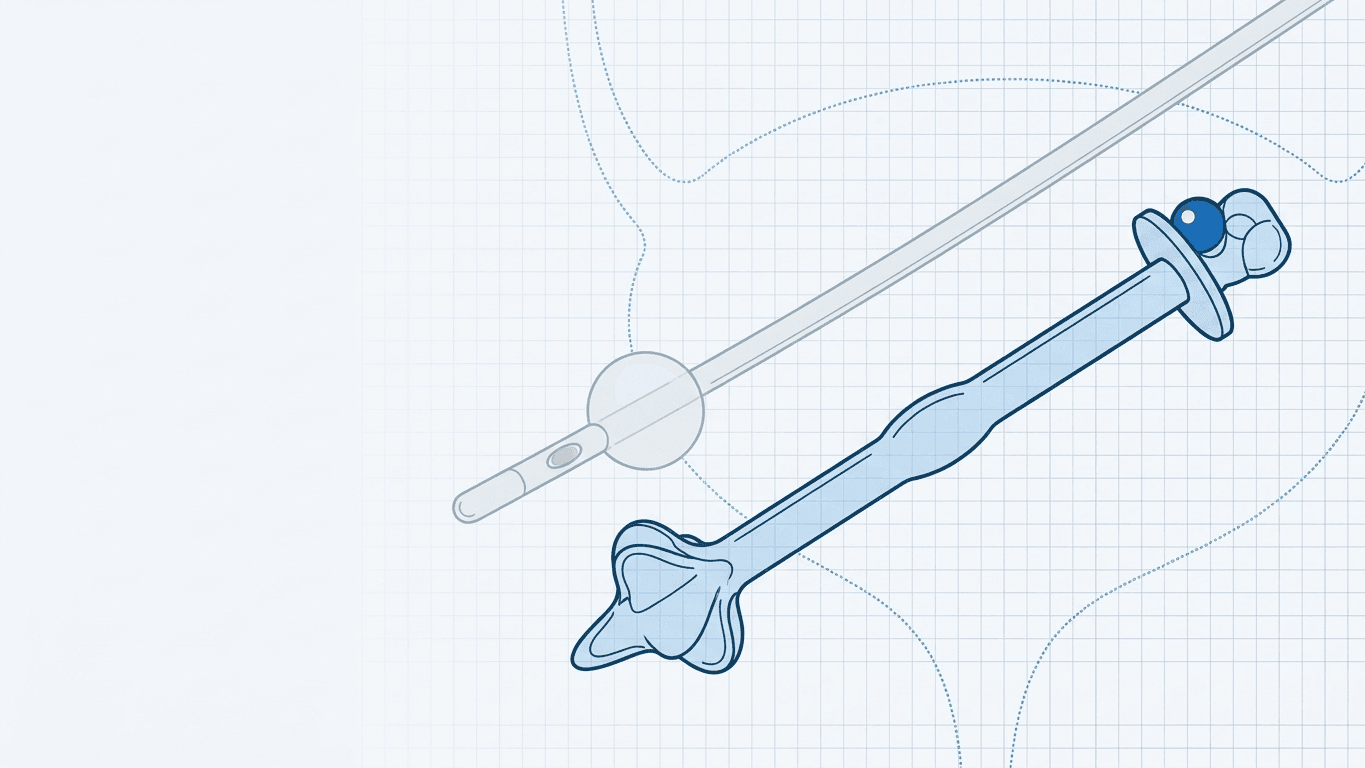
The balloon occupies the base of the bladder, and the drainage eyes are cut into the tip beyond it. When flow stops, 10–100 ml of urine can remain in the bladder; Feneley and colleagues describe this sump as likely to become infected and to seed fresh urine arriving from the kidneys.1 A separate source of retained urine lies outside the bladder: in bedside ultrasound measurements of hospitalised patients with Foley drainage, mean residual volumes were 96 ml in intensive care and 136 ml on the wards, which the authors traced mainly to air-locks in looped drainage tubing.8 Both point the same way: a catheter on free drainage does not reliably keep the bladder empty.
Mucosal contact, blockage and bypassing
Towards the end of drainage, the collapsing bladder wall meets the catheter tip and can be drawn into the drainage eye, which patients may feel as sharp pain; repeated contact can damage the urothelial barrier.1 Blockage and leakage around the catheter are common long-term complaints. In one community series cited by Feneley, 48% of 54 closely studied patients experienced blockage, 37% reported urine bypassing the catheter and 30% noted haematuria; bladder spasm makes these problems worse.1
Removal, cuffing and expulsion
Removal depends on the balloon deflating cleanly. Silicone balloons can creep and leave a rim, or ‘cuff’, after the water is withdrawn.1 In an audit of 154 patients with long-term catheters, 22 (14%) had experienced difficulty with removal in the previous year, and a cuff was noted in 60% of those cases.2 A balloon that will not deflate at all requires a stepwise sequence of interventions to release it.9
Two further mechanisms are specific to the balloon. A catheter pulled out while the balloon is still inflated — for example by a disorientated patient — can cause serious urethral injury. And in women with neurological conditions such as multiple sclerosis, a sudden bladder contraction can expel the catheter with the balloon inflated; if this happens repeatedly, the urethra is dilated and the sphincter mechanism may become incompetent.1
How much does indwelling time matter for infection?
More than any feature of catheter design, duration determines infection. The CDC/HICPAC guideline puts the daily risk of bacteriuria with catheterisation at 3% to 10%, approaching 100% after 30 days — the point the guideline treats as the boundary between short- and long-term catheterisation. It also notes that biofilm forms on catheters universally with prolonged use.3
The prevention message from both major guidelines is therefore about use, not hardware. CDC recommends minimising catheter use and duration in all patients, particularly those at higher risk such as women, older people and those with impaired immunity, and states that intermittent catheterisation is preferable to indwelling urethral or suprapubic catheters in patients with bladder emptying dysfunction.3 The IDSA guideline likewise identifies restricting catheterisation to appropriate indications and limiting its duration as the most effective way to reduce catheter-associated urinary tract infection (CAUTI).4
For device design, the implication is uncomfortable but important: changing how a catheter is retained or drained does not stop the clock. A device intended to stay in place for a month is, by the guideline definition, a long-term catheter, and needs the same infection surveillance.
Do catheter valves beat free drainage?
A catheter valve closes the drainage channel between voids, so the bladder fills and is emptied periodically instead of draining continuously. Feneley and colleagues argue that continuous drainage suppresses the periodic flushing that normally limits bacterial build-up, and that a manually operated valve restores it.1 The trial evidence is more modest.
- A systematic review of controlled trials comparing valves with drainage bags found two studies with 122 participants in total. Neither showed a statistically significant difference in bladder spasm or UTI, but patients clearly preferred the valve.5
- The CDC/HICPAC evidence review rated the evidence for valves in selected patients as moderate quality: greater patient satisfaction, no differences in bacteriuria or pain and bladder spasm, and most participants men. It found no data on bladder function, bladder or urethral trauma, or blockage, and lists the infection benefit of valves as an unresolved issue requiring further research.3
- In a randomised non-inferiority trial of 97 women sent home with a Foley catheter after urogynaecological surgery, 30-day UTI rates were 32.6% with a catheter valve and 33.3% with continuous drainage; women were significantly more satisfied with the valve.6
Taken together, valves appear to improve the experience of having a catheter without measurably changing infection rates in the short term. All of this evidence concerns valves added to balloon-retained catheters; it says nothing about how valve drainage behaves when the balloon is removed from the design.
| Approach | Retention | Drainage | What the evidence shows | Main limits |
|---|---|---|---|---|
| Intermittent catheterisation | None — catheter removed after each void | Periodic, complete | Preferred over indwelling catheters for bladder emptying dysfunction (CDC, Category II) | Needs hand function, cognition and several catheterisations a day |
| Foley catheter, free drainage | Inflated balloon | Continuous, into a bag | Long clinical experience; residual sump, cuffing, expulsion and trauma well described | CAUTI risk rises daily; bag dependence |
| Foley catheter with a valve | Inflated balloon | Periodic, through a valve | Patient preference; UTI rates comparable to free drainage in available trials | Still balloon-retained; infection benefit unresolved |
| Intraurethral valve-pump (inFlow) | Fins and flange, no balloon | Periodic, pump-assisted | Comparable post-void residual to intermittent catheterisation and better quality of life in women who completed treatment; US De Novo granted 2014 | More than half of enrolled women withdrew early (discomfort, leakage) |
| Balloon-free valve catheter (Silicon Life) | Four-lobed tip, no balloon | Periodic, through a ball-bead valve | One single-centre, single-arm study: 18 of 19 completers met a comfort and convenience threshold | Registered in China only, for women; 4 of 23 withdrew after dislodgement or removal; no comparative or infection data |
Source: CDC/HICPAC 2009; van den Eijkel & Griffiths 2006; Dhariwal et al. 2021; Chen et al. 2005; FDA DEN130044; Silicon Life clinical study report (unpublished).
What happens when the balloon is removed?
Balloon-free devices for the female urethra are not new, and the best-studied example is instructive. The inFlow intraurethral valve-pump is a replaceable urethral insert held by fins and a flange, with a valve and pump that the user activates to void. In a multicentre, single-arm crossover study of women with a hypocontractile or acontractile bladder who were using intermittent catheterisation, 273 women entered the study; 169 withdrew early, mainly because of initial discomfort and leakage, and 77 completed the treatment phase. In those who completed it, post-void residual volume was comparable to intermittent catheterisation (16.1 ml vs 20.3 ml) and incontinence-specific quality of life improved significantly.7
The device received a De Novo grant from the US FDA in October 2014.10 A later review of seven peer-reviewed studies concluded that about half of women tolerate it, and that those who do benefit from a low infection rate, ease of use and greater autonomy.11 The lesson for any balloon-free design is that retention and comfort have to be solved together: without a balloon, fit to the individual urethra determines both whether the device stays in place and whether it leaks.
Where Silicon Life fits
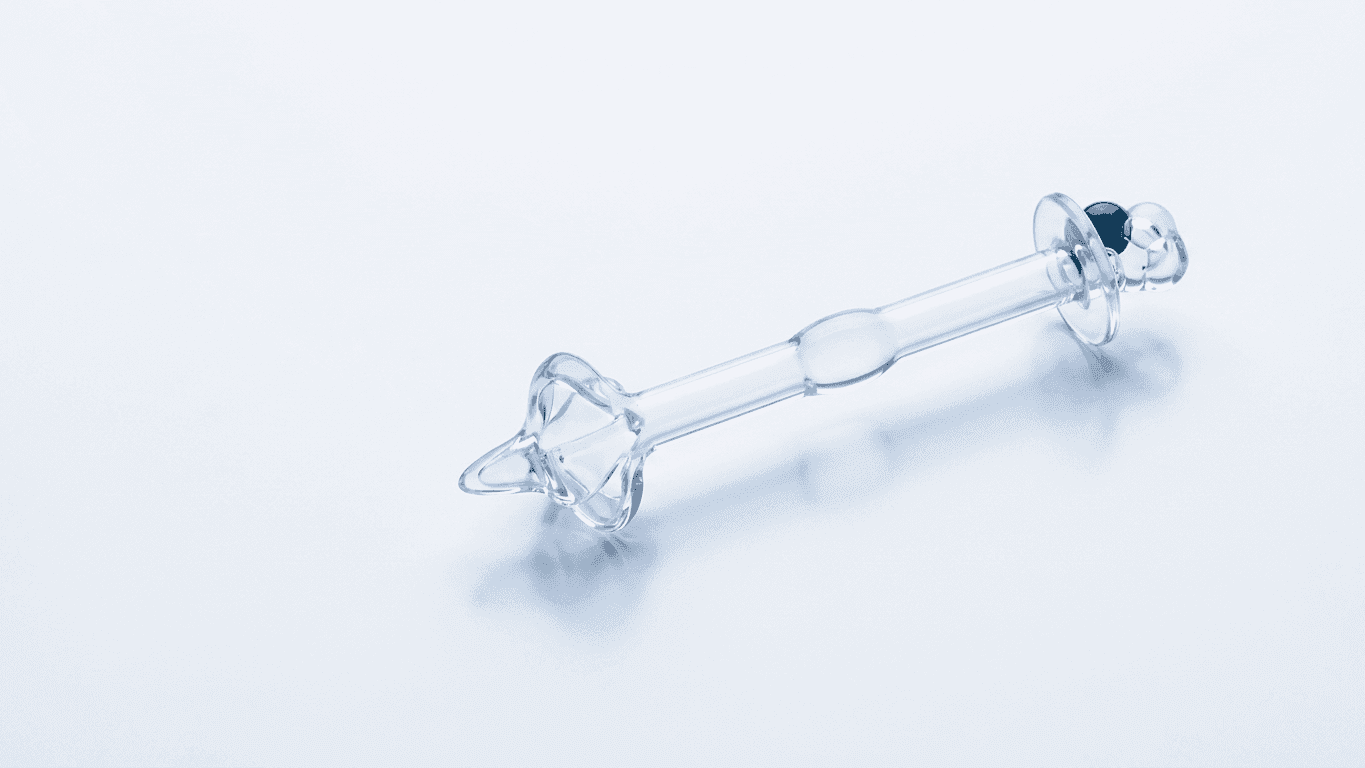
Silicon Life’s Disposable Sterile Controlled Catheter is a balloon-free indwelling catheter: a four-lobed (quatrefoil) silicone tip retains it at the bladder neck, a baffle rests outside the urethral meatus, and a PTFE ball-bead valve keeps it closed between voids. The patient or carer opens the valve by squeezing the ball bead into a bulged section of the shaft and closes it again afterwards, without a drainage bag. A healthcare professional places the catheter and replaces it after up to 30 days. It is available in 11 models across three French sizes and three effective lengths.
Its regulatory scope is narrow and should be read that way. The catheter is registered in China as a Class II medical device (registration no. 鄂械注准20252145807) for female patients with voiding dysfunction. It is not registered or approved for sale in any other market and is not indicated for men.
The clinical evidence is one interventional, single-centre, single-arm study at Tongji Hospital, Wuhan, conducted from January to June 2025. Of 23 women enrolled, 19 completed 30 days with one catheter each. Eighteen of the 19 (94.7%; 95% CI 74.0–99.9%) reached the predefined convenience and comfort threshold, against a prespecified target of 70%. No adverse events occurred among the 19 who completed the study. Four participants withdrew after the catheter dislodged or was removed because of discomfort; all four events were moderate and non-serious and resolved without sequelae, and the investigators attributed them to a mismatch between patient anatomy and the only two sizes studied.12
Those withdrawals echo the inFlow experience: in a balloon-free design, sizing is part of the safety case. The investigators recommended a wider size range; the company’s current line comprises 11 models. The study was not designed to measure infection, compare the catheter with a Foley or valve catheter, or follow women through repeated monthly replacements, so it cannot answer the questions above.
What remains unknown
- No randomised trial has compared balloon-free retention with a balloon-retained Foley in women for CAUTI, urethral injury or quality of life.
- Valve evidence comes mainly from balloon-retained catheters, short follow-up and, in several studies, predominantly male participants.3
- For long-term catheterisation more broadly, a Cochrane review found no eligible trials comparing alternative routes of catheter insertion and only sparse data on catheter policies.13
- Which women tolerate intraurethral devices — by urethral length, pelvic floor function, hand function or diagnosis — is not well defined.
- Long-term data across repeated device replacements, including urethral changes, are lacking for balloon-free designs.
Practical considerations for clinical teams
- Start with the indication. Confirm that an indwelling device is needed and that intermittent catheterisation is not feasible.3
- Check the user. Any valve-based device needs a patient or carer who can open and close it reliably and recognise when the bladder is full.
- Plan for fit. For balloon-free devices, expect an initial tolerance and sizing phase, and record leakage, discomfort and dislodgement.
- Keep CAUTI surveillance unchanged. A month-long device is a long-term catheter; apply the same review of continued need and infection monitoring.3
- Confirm regulatory status locally. Use only devices authorised in your jurisdiction, and follow their Instructions for Use.
Frequently asked questions
Does removing the balloon reduce urinary tract infection?
Not on current evidence. No comparative trial has tested it. The strongest known driver of infection is how long a catheter stays in, which a different retention method does not change.3
Are catheter valves safe to use instead of a drainage bag?
In the trials available, valves were preferred by patients and did not change UTI rates compared with free drainage, including in women discharged after urogynaecological surgery.65 CDC still lists their infection benefit as unresolved and notes the lack of data on bladder function and trauma.3
Who is a candidate for a balloon-free intraurethral device?
In published studies, women with impaired bladder emptying who could not or would not continue intermittent catheterisation, and who could operate the device. Tolerance is the main limitation: about half of women in the inFlow literature continue with it.11
Can Silicon Life’s catheter be used outside China or in men?
No. It is registered only in China and only for female patients with voiding dysfunction. Clinicians and partners outside China can request the Instructions for Use and the clinical study report for information.
References
- 1Feneley RCL, Hopley IB, Wells PNT. Urinary catheters: history, current status, adverse events and research agenda. J Med Eng Technol. 2015;39(8):459–470
- 2Parkin J, Scanlan J, Woolley M, Grover D, Evans A, Feneley RCL. Urinary catheter ‘deflation cuff’ formation: clinical audit and quantitative in vitro analysis. BJU Int. 2002;90(7):666–671
- 3Gould CV, Umscheid CA, Agarwal RK, Kuntz G, Pegues DA; Healthcare Infection Control Practices Advisory Committee. Guideline for Prevention of Catheter-Associated Urinary Tract Infections 2009. Centers for Disease Control and Prevention (published in Infect Control Hosp Epidemiol. 2010;31(4):319–326)
- 4Hooton TM, Bradley SF, Cardenas DD, et al. Diagnosis, prevention, and treatment of catheter-associated urinary tract infection in adults: 2009 International Clinical Practice Guidelines from the Infectious Diseases Society of America. Clin Infect Dis. 2010;50(5):625–663
- 5van den Eijkel E, Griffiths P. Catheter valves for indwelling urinary catheters: a systematic review. Br J Community Nurs. 2006;11(3):111–114
- 6Dhariwal L, Chiu S, Salamon C. A urinary catheter valve is non-inferior to continuous bladder drainage with respect to post-operative UTIs: a randomized controlled trial. Int Urogynecol J. 2021;32(6):1433–1439
- 7Chen TY, Ponsot Y, Carmel M, Bouffard N, Kennelly MJ, Tu LM. Multi-centre study of intraurethral valve-pump catheter in women with a hypocontractile or acontractile bladder. Eur Urol. 2005;48(4):628–633
- 8Garcia MM, Gulati S, Liepmann D, Stackhouse GB, Greene K, Stoller ML. Traditional Foley drainage systems—do they drain the bladder? J Urol. 2007;177(1):203–207
- 9Patterson R, Little B, Tolan J, Sweeney C. How to manage a urinary catheter balloon that will not deflate. Int Urol Nephrol. 2006;38(1):57–61
- 10US Food and Drug Administration. De Novo classification request DEN130044: inFlow Intraurethral Valve-Pump (Vesiflo, Inc.), granted 14 October 2014
- 11Hartigan SM, Dmochowski RR. The inFlow intraurethral valve-pump for women with detrusor underactivity: a summary of peer-reviewed literature. J Spinal Cord Med. 2022;45(4):489–497
- 12Silicon Life. Clinical study report: Disposable Sterile Controlled Catheter in women unable to void voluntarily — interventional, single-centre, single-arm study, Tongji Hospital, January–June 2025 (unpublished; summary on the product page)
- 13Niël-Weise BS, van den Broek PJ, da Silva EMK, Silva LA. Urinary catheter policies for long-term bladder drainage. Cochrane Database Syst Rev. 2012;(8):CD004201
Silicon Life. Balloon-free retention and valve drainage in women’s indwelling catheters: what the evidence says. SILICON·LIFE Insights. 11 October 2026.

Silicon Life develops urological devices and implantable systems in Wuhan, China. Its Insights are written for healthcare professionals, with the sources for each article listed in full.
This article is provided for educational purposes for healthcare professionals. It does not constitute medical advice and does not replace the Instructions for Use of any device. Product availability and indications differ by country.
New articles on urology devices and implant engineering.
Clinical reviews, engineering notes and company news from Silicon Life, sent when new articles are published.
Occasional emails. Unsubscribe at any time.