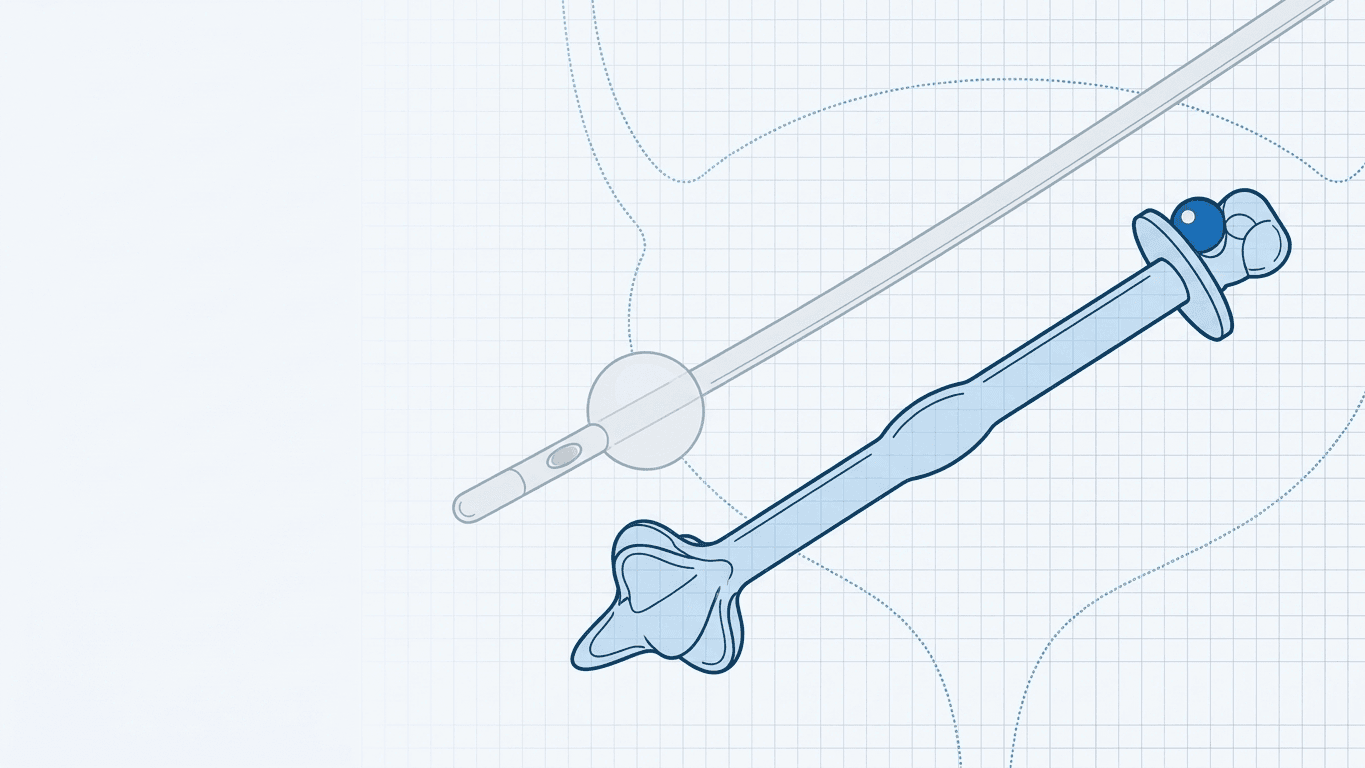

What exactly has failed when a bladder empties poorly?
A referral labelled “underactive bladder” may describe slow flow, incomplete emptying, reduced sensation, straining or a mixture of storage and voiding symptoms. Detrusor underactivity is more specific: pressure-flow testing identifies a contraction whose strength or duration is inadequate for effective emptying. Acontractility describes the absence of a demonstrable detrusor contraction during the investigation. These distinctions matter because symptoms, residual urine and a urodynamic observation describe different aspects of the problem. 1 18
The first architecture decision is consequently a measurement decision. A pump, a drainage lumen, an outlet intervention and a neural stimulator address different contributors to poor emptying. Similar residual volumes can occur with weak contraction, outlet obstruction or both. A device programme that recruits solely on residual volume risks combining patients with very different mechanical requirements and then averaging away the reason for success or failure. The phenotype should preserve contraction, outlet behaviour and filling function as separate observations. 1 2
Pressure is an observation within a flow system
Urodynamic detrusor pressure is calculated as intravesical pressure minus abdominal pressure: Pdet = Pves − Pabd. A bladder pressure trace alone includes abdominal contributions. In a compressor study, an increase in intravesical pressure may result directly from applied external force. Calling that increase restored muscle contractility would confuse the device's action with biological recovery. Pressure, flow and the source of applied force should remain distinguishable in the results. 2 14
The same caution applies to peak flow. A short high-flow burst can coexist with substantial residual urine; a lower flow sustained for longer can move more volume. For an engineering comparison, the useful record includes initial volume, voided volume, residual volume, elapsed time and pressure throughout the event. The pressure-flow trajectory describes the system more fully than a single peak. The clinical interpretation still depends on the patient's outlet and the conditions of measurement. 1 2
The bladder contractility index, commonly expressed as pressure at maximum flow plus five times maximum flow, is an approximation used in particular diagnostic settings. A low index should be interpreted in its validated population and alongside obstruction assessment. It is neither a direct measurement of muscle histology nor a universal classifier for every woman, neurological lesion or implanted actuator. Osman and colleagues' terminology review specifically emphasizes the limitations of available diagnostic approximations. 1
Acontractility during a test also deserves careful wording. The finding records what occurred under the investigation's conditions. Its cause, permanence and potential response require clinical interpretation. Labeling every absent contraction as terminal fibrosis would close off distinctions that the measurement itself leaves unresolved. This is especially consequential when a development programme uses the label to predict that all neural treatments will fail and that mechanical compression is the inevitable next intervention. 1 18
Storage function changes the engineering question
An emptying device operates between voids as well as during them. A compliant reservoir can accept increasing volume with a relatively small pressure rise. A poorly compliant bladder may develop concerning pressure during filling even with little active contraction. The EAU guideline therefore assesses filling cystometry, pressure-flow behaviour and, where appropriate, imaging together. Neurological patients may have more than one dysfunction, including overactivity during storage and inadequate emptying during voiding. 2
For a perivesical sleeve, storage compliance is part of the intervention. A wrap that moves urine effectively but restricts expansion can exchange an emptying problem for a storage problem. The appropriate comparator includes the bladder with the implanted system present and relaxed. Measuring only the activated stroke misses the many hours during which the implant is simply occupying the pelvis and contacting the organ. This is an engineering implication of the clinical emphasis on filling function. 2 14
Neurological anatomy supplies useful hypotheses, rather than a complete eligibility algorithm. Sacral or peripheral lesions may impair the motor pathway; suprasacral disease may involve detrusor-sphincter dyssynergia. Mixed findings, evolving disease and differences between spinal segments and vertebral levels complicate simple level-based labels. Evaluation should record the observed outlet and detrusor behaviour instead of assuming that a named lesion guarantees a relaxed outlet. 2
Why 40 cmH₂O is an inadequate universal design rule
McGuire and colleagues followed 42 myelodysplastic patients for a mean of 7.1 years. Among 20 patients whose intravesical pressure at leakage was at most 40 cmH₂O, none had reflux and two had ureteral dilatation. Among 22 with higher leakage pressure, 15 had reflux and 18 had dilatation. Those observations established an influential association within that cohort. They concern leakage pressure, outlet behaviour and the clinical course of myelodysplasia. 3
Applying that cohort split to a brief externally induced void introduces several changes. That transformation changes the population, pressure definition, exposure duration and intervention simultaneously. It also converts an observational association into a guarantee. A compressor set just below that value could still cause harmful local loading, incomplete drainage or elevated storage pressure. Conversely, a higher transient voiding pressure requires interpretation in its own setting, rather than automatic equivalence to the cohort's leakage-pressure exposure. 2 3
Current EAU neuro-urology guidance explicitly describes detrusor leak-point pressure as having insufficient sensitivity to estimate upper-tract risk on its own. The guideline gives broader importance to urodynamic quality, repeated investigation where needed, filling function, pressure-flow testing and video assessment. This current context belongs next to the historical study whenever the number is used to guide an engineering argument. It prevents a familiar value from taking on a precision its source never supplied. 2
Pressure measurement should distinguish absolute pressure, change from baseline and detrusor pressure after abdominal subtraction. Duration matters as well: a brief actuation peak and sustained filling pressure represent different exposures. A specification written merely as “less than 40” leaves all of these choices unstated. A meaningful test plan names the signal, reference, sampling and filtering, permitted duration, stopping behaviour and conditions under which the system was challenged. These are proposed reporting requirements derived from the clinical measurement problem. 2
Consider two hypothetical bench tests that each display a maximum intravesical pressure of 35 cmH₂O. In the first, an open outlet allows a large volume to drain and pressure quickly falls. In the second, an obstructed outlet allows almost no flow while pressure persists. The matching maxima conceal different work delivered, emptying results and failure behaviour. The example is illustrative; it supplies no clinical safe pressure or duration. Its purpose is to show why a pressure trace needs a flow and volume record.
A second distinction is between pressure within the lumen and contact stress at the tissue interface. A soft sleeve can generate an apparently acceptable average fluid pressure while creating uneven loading at an edge, fixation point or fold. Engineers should therefore examine contact geometry and tissue response as well as the intravesical trace. The magnetic-bladder study's attention to fixation and hydrogel coating illustrates that these interfaces are separate design problems. Its short follow-up leaves their chronic behaviour open. 14
The practical conclusion is a pressure-flow-volume-time acceptance envelope, justified for a defined use case. It should include the relaxed implant during storage, outlet obstruction challenges, failed actuation and recovery. Such an envelope would be an input to clinical and regulatory development, requiring validation. This review proposes the framework; it assigns no universal numerical limits to patients or future products.
Denervation research: strong evidence of change, limited evidence of inevitability
Wang and colleagues' 2023 bilateral pelvic nerve injury study provides an informative bridge between neural injury and bladder-wall change. The experiment allocated 45 rats across sham, three-day and 28-day groups. Urodynamics used six animals per group; RNA sequencing used three per group. These assay denominators are smaller than the allocation total and belong alongside the measurements. Treating all 15 animals in a group as the sample for every assay exaggerates the effective evidence base. 4
Maximum intravesical pressure averaged 38.53 cmH₂O in sham animals, 16.63 at three days and 26.25 at 28 days. Reported voiding efficiency was 95.20%, 5.35% and 27.17%, respectively. The partial functional recovery and persistent impairment are both visible. Because these are intravesical measurements in a rat nerve-crush model, their numerical relation to a human voiding pressure is descriptive rather than a diagnostic threshold. 4
View chart data
| Category | Voiding efficiency |
|---|---|
| Sham | 95.2 |
| Three days after injury | 5.35 |
| 28 days after injury | 27.17 |
Mean voiding efficiency within one experiment; six rats per group. The chart shows functional recovery with persistent impairment, rather than an inevitable terminal stage. It is not a comparison with a human treatment or a pig device.
- Reported 95% confidence intervals: sham 92.89–97.51%; day 3 2.34–8.36%; day 28 20.54–33.80%. Total study allocation: 45 rats; urodynamics: 6 per group; RNA sequencing: 3 per group.
Source: Wang et al., Biomolecules 2023, Table 2 (source 4).
Histology and transcriptomics also changed over time. The early phase emphasized proliferation and inflammation; the later phase showed extracellular-matrix remodelling and fibrosis-related changes. The paper reports no significant early change in detrusor thickness or collagen content at three days, followed by significant later changes. The experiment therefore supports a temporal account more nuanced than immediate, uniform replacement of smooth muscle with collagen. 4
The authors' design is mainly descriptive. Whole-tissue RNA sequencing captures signals from several cell populations, so a pathway association leaves questions about the responsible cells and causal direction. Demonstrating that a molecular pathway changes after injury differs from showing that blocking it restores clinically meaningful emptying. It also differs from proving that persistent human underactivity always follows the same trajectory. The paper itself identifies further mechanistic work as necessary. 4
For translation, reversibility is a particularly important boundary. A nerve-crush injury with partial recovery over weeks is distinct from complete nerve transection, chronic obstruction, ageing-associated dysfunction and mixed neurological disease. Neither a three-day rat observation nor a 28-day tissue finding defines a deadline after which a human bladder becomes irreversibly fibrotic. The review therefore uses this experiment to motivate longitudinal tissue and functional assessment, rather than a universal treatment timetable. 4
It also offers a useful trial-design lesson. Measuring only pressure would show partial recovery; adding residual volume and efficiency shows how much impairment remains. Adding tissue assays suggests possible biological contributors. A future intervention study should preserve these different levels of evidence instead of using a molecular improvement as a substitute for emptying or renal outcomes. That distinction allows a promising mechanistic result to retain its value without being promoted into efficacy prematurely.
Drug evidence supports restraint without proving universal biological futility
Barendrecht and colleagues reviewed ten randomized studies of parasympathomimetics: three reported benefit relative to control, six found no significant benefit and one reported worsening. The review concluded that available studies failed to support their use, particularly given adverse effects. Current EAU neuro-urology guidance recommends against prescribing parasympathomimetics for underactive detrusor. This is an evidence-based prescribing boundary, rather than proof that every drug approach to every underactivity phenotype is mechanically impossible. 5 2
Reducing outlet resistance is a different therapeutic mechanism from increasing detrusor contraction. The female LUTS guideline discusses alpha-blockers and other interventions in selected settings while emphasizing the generally limited evidence for many underactivity treatments. For a device team, the implication is to document concurrent outlet treatment and its timing. Improved flow after a combined intervention otherwise becomes difficult to assign to either the implanted system or the altered outlet. 18
The wider CURE-UAB review documents an active research field spanning mechanisms and potential treatments. It is useful context for unmet need, but it supplies no basis for declaring a new actuator clinically superior to all existing approaches. The constructive research question is which measurable function an architecture adds for a defined phenotype, with what burden and uncertainty. A clear target indication makes a stronger development case than a sweeping claim that pharmacology and neural approaches have exhausted their possibilities. 13
Neuromodulation and direct motor stimulation address different pathways
Sacral neuromodulation can improve non-obstructive urinary retention in selected patients. Its mechanism involves neural modulation and is incompletely resolved. The current female LUTS guideline describes a test phase, variation in response and lower response in some patients with suspected loss of intrinsic contractility or neurological dysfunction. It recommends sacral stimulation for women with underactive bladder refractory to conservative management. That evidence rules out a blanket claim that the diagnosis of underactivity alone makes neuromodulation futile. 18
The test phase has an important consequence for interpreting published success. A cohort of permanent implant recipients has already passed through clinical selection and usually a stimulation assessment. Its long-term percentage answers a question about those recipients, not every patient referred with retention. Hospital evaluation should ask for the number assessed, tested, implanted and retained at follow-up, together with the definition of improvement at each stage. This denominator sequence is central to comparing an established therapy with a new device programme.
Peeters and colleagues studied 217 permanent implant recipients at one tertiary centre, with mean follow-up of 46.88 months. The idiopathic-retention subgroup had 73% success and 58% cure under the study's definitions. Across the entire mixed-indication cohort, 41% required at least one surgical reintervention. The retention efficacy and overall reintervention figures use different populations; placing them together requires those labels. Changes in hardware and practice also limit direct application of this historical cohort to current products. 7
A later mechanical-assistance trial should use the same discipline. A large benefit among people who tolerate a prototype may coexist with substantial failure during fitting or implantation. Report the early stages as outcomes of the care pathway. Excluding unsuccessful candidates can be useful for understanding mechanism, but the hospital still needs to know how many people proceed successfully through the whole pathway and how much staff work that process requires.
The historical counterexample: sacral anterior root stimulation
Sacral anterior root stimulation directly recruits motor pathways and can produce post-stimulus voiding because sphincter and detrusor relaxation have different time courses. It has a substantial clinical history. Brindley and colleagues' first-50-case report described long-term use as well as complications, and the later systematic review by Guiho and colleagues included 38 studies covering 1,147 implantations. The latter reported use for micturition in 85.9% of recipients. These are selected spinal-cord-injury populations, rather than a general underactive-bladder success rate. 8 9
This pathway retains requirements and trade-offs. Intact peripheral innervation and a responsive detrusor matter, while associated sacral deafferentation brings irreversible consequences. The 2022 review links the decline in implantation to complications and the development of alternatives. The evidence supports a differentiated account of neural architectures: changing sensory modulation into direct motor recruitment changes both the potential benefit and the anatomical prerequisites. 9
FDA's Vocare record provides a regulatory counterexample to a broad absence argument. H980005 was approved on 28 December 1998 through the Humanitarian Device Exemption pathway, under product code PAT. Its indication specifies clinically complete spinal-cord lesions with intact parasympathetic bladder innervation, skeletal maturity and neurological stability. An HDE record belongs to a separate pathway from ordinary PMA and 510(k) searches. It establishes a specific historical authorization, without establishing current commercial availability. 6
This distinction changes how registry analysis should be used. Product codes describe regulatory categories, and decisions can include supplements, changes and pathway-specific records. A search finding no records in two selected codes supports only that bounded search result. It provides little information about clinical need, utilization, sales or every possible competing technology. For evaluation, start with the specific device, pathway, current labelling and jurisdiction. A record-count comparison is a supporting discovery tool, rather than the physiological premise of the article.
Drainage, pumping and valve control: the human evidence boundary
Intermittent catheterisation and indwelling drainage remain important management options when emptying is inadequate. The practical choice includes hand function, cognition, assistance, anatomy, access to supplies and personal preference. Current EAU neuro-urology guidance emphasizes shared decisions and training, while describing complications of both approaches. Its commonly described catheterisation frequencies and volumes are clinical context; an individual schedule requires assessment. A new drainage device should show how its use changes the actual care pathway. 2
Infection comparisons illustrate the danger of turning observational associations into device promises. Krebs and colleagues' retrospective study of 1,104 people with chronic neurogenic lower urinary tract dysfunction found the highest symptomatic infection odds among transurethral indwelling-catheter users. The comparator and patient characteristics matter: an odds ratio relative to spontaneous voiding is different from a randomized comparison with intermittent catheterisation. Confounding by disease severity and the reason a catheter was chosen remains possible. 11
Counter-evidence deserves equal visibility. Neumeier and colleagues' 2023 observational comparison of 505 patients found no significant difference in urinary infection frequency between indwelling and intermittent groups. That result also has design and population limits. Together, the studies argue for explicit infection definitions, follow-up and patient mix, while cautioning against a universal numerical infection advantage for one drainage method. The current EAU discussion likewise contains a more qualified account than a simple “intermittent always prevents infection” statement. 19 2
For hospital procurement, drainage performance and staff burden should therefore be measured alongside infection. Useful endpoints include successful emptying, residual volume, unplanned replacement, leakage, discomfort, time to assistance and interruptions to sleep or daily activities. These are proposed evaluation domains, rather than claims that a particular system improves them. A programme centred solely on bag avoidance may miss the work of fitting, troubleshooting and obtaining replacement supplies.
An active pump provides energy that a valve only controls
The inFlow intraurethral valve-pump offers an instructive mechanistic distinction. Its internal pump draws urine from the bladder under patient control, whereas a passive valve opens a drainage path. FDA granted DEN130044 on 14 October 2014 and classified the device as Class II under 21 CFR 876.5140, product code PIH. That grant applies to the identified device and indication; it confers no authorization or performance evidence on another company's catheter. 10
Hartigan and Dmochowski's review describes a consistent tension: effective emptying and improved experience among women who tolerate the device, alongside substantial early discontinuation. The earlier multicentre study enrolled 273 women and had 77 treatment completers. Its comparison with intermittent catheterisation used a prospective, single-arm crossover design, rather than a randomized treatment allocation. 22 The review's approximate “half tolerate” summary also compresses differing studies and stages, so it should remain a broad summary rather than an individual forecast. 12
The lesson extends beyond urethral inserts. A successful mechanical stroke is only one part of sustained use. Fit, irritation, leakage and expulsion may prevent users from reaching the point where emptying efficacy can be assessed. Attrition is consequently relevant to engineering, clinical interpretation and procurement. It should remain visible in the headline outcomes of an evaluation rather than being confined to an appendix about excluded participants.
Silicon Life's marketed catheter has a narrower role
Silicon Life's Disposable Sterile Controlled Catheter is a China-only Class II device for female patients with voiding dysfunction. Its balloon-free quatrefoil tip provides retention; a separate PTFE ball bead operates as the valve. The patient or carer squeezes the external end to move the bead and open or close the drainage path. It is a hand-operated drainage catheter, not an electrically driven pump. The current product range lists 11 models across 35, 45 and 55 mm effective lengths and Fr 12, 16 and 20 sizes. 17
The company's unpublished Tongji Hospital study was interventional, single-centre and single-arm: 23 women enrolled and 19 completed 30 days. Eighteen of the 19 completers met the combined convenience-and-comfort score threshold of at least 4, or 94.7% with an exact binomial 95% interval of 74.0–99.9%. Four participants withdrew after dislodgement or removal for discomfort; the events were moderate, non-serious and resolved. Investigators attributed these withdrawals to anatomical mismatch with the two sizes studied. These results concern comfort and convenience, with important attrition and no concurrent control group. 17
For an assessment of emptying architecture, that study supports a limited proposition about initial use in the studied women. It leaves comparative infection prevention, restoration of detrusor strength, renal protection and repeated long-term replacement outcomes unestablished. The difference between a wider listed model range and the two trial models also leaves a need for model-specific evidence. It would be inappropriate to use the artificial-bladder research results to fill those clinical gaps.
The earlier review of balloon-free retention and catheter valves covers catheter complications and valve evidence in more detail. Here the catheter serves a different analytical purpose: it demonstrates how reducing outflow resistance differs from supplying active emptying work. Its registration and study should be evaluated on their own terms. The product page identifies its China-only, female indication and offers the current product documentation.
What the magnetic soft robotic bladder demonstrated
Yang and colleagues' 2022 study combines simulation, a silicone bladder mimic, materials tests and porcine implantation. It examined four magnetic patterns at six particle volume fractions, a total of 24 designs. The optimized device used a magnetic silicone composite with a hydrogel-coated interface. The reported design objective combined pressure generation with weight, rather than pressure alone. These are useful engineering results within a defined experimental system. 14
The actuation physics also affects translation. The paper models both magnetic torque and magnetic body force. Removing the field-gradient contribution reduced simulated pressure markedly, and the authors identify body force as the major contribution. Calling this a torque-only system that avoids translational attraction would therefore invert the primary result. The relevant design question includes how field strength, gradient, distance and orientation jointly load the device and its fixation. 14
The representative source was a 10 cm cubic permanent magnet, with a 20 mm minimum separation in the bench and simulation arrangement. The CT demonstration reported a minimum actuation distance of 2.14 cm. Distance, field geometry and orientation are part of the experimental conditions. Changing the external magnet or its position requires new characterization, including the effects of patient geometry and tissue depth. 14
In the bench arrangement, the bladder substitute was cast from silicone with a 250 mL capacity. The optimized system produced a 38.5 cmH₂O pressure increase and expelled 203.7 mL. A synthetic mimic supplies controlled mechanics; tissue variability and biological interfaces require separate tests. Its calculated expelled fraction is approximately 81.5%, using the stated initial capacity and expelled volume. That calculation describes the experiment, rather than a human performance expectation. 14
The porcine demonstration is informative and short
The in vivo model used sacral denervation to produce inadequate voiding, including a relatively relaxed sphincter. This outlet condition is central to interpreting compression-assisted emptying. A system tested against that outlet has yet to demonstrate equivalent behaviour against a dyssynergic or obstructed outlet. The publication describes the model's nerve levels somewhat differently between the main results and surgical methods, so this review retains the broader description rather than converting it into a precise human lesion category. 14
The study reports mean pressure increases of 40.90 ± 11.62 cmH₂O at postoperative day seven and 35.55 ± 6.04 at day 14. A representative repeated urodynamic cycle expelled 225 mL after a 260 mL infusion, with peak flow of 18.9 mL/s and a void lasting about 55 seconds. The derived expelled fraction is 86.5%. The day-14 CT sequence was a separate, shortened experiment: it began with 330 mL and showed 110 mL expelled during the imaging interval. The results should therefore remain separate, with their initial volume and observation duration specified. 14
No reflux was observed in the reported CT assessment. The paper also reports a small amount of inflammation at the bladder serosal contact layer and increasing urinary white-cell counts, which the authors considered potentially related to daily catheterisation. Those observations remain part of the short-term safety record, even with plausible alternative causes. The available report also leaves limited clarity about the independent animal denominator underlying every repeated measurement; repeated cycles should not be treated as independent animals. 14
These findings support proof of mechanical assistance in a preclinical setting. They leave chronic tissue response, infection, fixation stability, repeatability across animals and durable renal outcomes open. A 14-day implant observation provides a different kind of evidence from years of human exposure, regardless of how familiar the implant materials may be in other applications. The tissue-device interface is specific to its geometry, movement and location.
Fatigue cycles and calendar ageing require separate evidence
The paper's 1,000-cycle bench test ran over roughly 20,000 seconds and retained pressure generation. That duration is about 5.6 hours, even though the number of strokes corresponds to months of use under an assumed daily frequency. Accelerated cycling probes mechanical repetition; calendar exposure probes processes such as chemical ageing, coating changes, tissue encapsulation and fixation remodelling. One test leaves the other questions open. 14
For scale, an illustrative schedule of six complete voiding strokes per day produces 21,900 strokes over ten 365-day years. A one-million-cycle target would be about 46 times that count. Such arithmetic can help size a test programme, but it supplies no validated acceleration factor or equivalence to implant life. Micro-actuations, fault recovery and variable loads could produce a different duty cycle. Their contribution belongs in the specification rather than in a retrospective rationale invented to justify a large number.
The same principle applies to geometry and power. A comparison between prototypes should preserve the magnetic source, minimum distance, orientation, model material, outlet condition and initial volume. These parameters determine what the pressure number means. A smaller receiver or deeper implant may change the task considerably. The relevant question is whether a complete system works across intended conditions with acceptable tissue interaction, rather than whether two published peak pressures look similar.
Sensing and intent control add separate validation problems
Arab Hassani and colleagues integrated a soft capacitive sensor with a shape-memory-alloy actuator and tested the system in three anaesthetized rats. They reported 71–100% voiding efficiency and sensor sensitivity of 0.7 µF/litre during filling. The integrated design addressed an important mechanical conflict: a sensor needs to follow expansion while the actuator needs enough stiffness and force to compress. The result supports the feasibility of their particular sensing-actuation interface. 15
The details prevent overstatement. The device used wrinkled gold electrodes, and capacitance increased with filling in the described arrangement. Its compression and restoration wires had different dimensions and thermal behaviour. The experiments involved controlled activation; the discussion proposed future wireless deployment and repeated calibration. A continuously autonomous, long-term controller stopping safely at an accurately detected empty state would require additional evidence. Future automatic triggering and stopping logic require prospective validation in awake models. 15
Thermal actuation makes interface temperature and energy use part of the system test. Energy scales with geometry, material, heat loss and duty cycle, so a ratio of bladder volumes supplies insufficient grounds to assign a human joules-per-void requirement. A useful comparison would measure the electrical input, mechanical output, tissue temperature distribution and cooldown under the intended load. This is a proposed development test, rather than an extrapolated performance number from the rat system. 15
Mickle and colleagues demonstrated a wireless strain-sensing and optogenetic neuromodulation platform in rats. A carbon-black-doped silicone strain gauge tracked bladder activity, and a closed-loop system modulated sensory afferents in an acute cystitis model. The work illustrates sensing, telemetry and event detection. It addresses pathological frequent voiding, rather than mechanically emptying an acontractile bladder. Translating its control result into restored motor evacuation would change both the disease model and the therapeutic action. 16
These sensor studies also show why sensitivity differs from accuracy. A signal can change substantially with volume yet remain vulnerable to geometry, posture, motion, calibration and tissue evolution. For a future device, volume estimation should be compared with an independent reference across filling, emptying and deliberate faults. Test a missed void and partial emptying as well: resetting the zero after every apparent event could conceal retained urine if the event detector mistakes incomplete drainage for an empty bladder.
An intent classifier needs clinically meaningful error definitions
An EEG-derived command introduces another distinct measurement problem. Overall classification accuracy depends on the distribution of examples. In an illustrative set containing 95 no-command windows and five intended commands, a classifier that always predicts no command scores 95% while missing every command. This arithmetic explains why an accuracy target alone is incomplete. A development study should report sensitivity to intended commands, false activation frequency, missed commands, latency and performance during movement or distraction.
The controller must also distinguish permission from safe operating conditions. A user may intend to void while the outlet is obstructed, the sensor is unavailable or a wireless link is unstable. Proposed fault tests should therefore examine how intent, measured state and actuator enablement interact. User cancellation, loss of communications and recovery after a failed stroke deserve explicit behaviour. The appropriate clinical thresholds remain programme-specific and require validation.
Silicon Life describes an investigational BCI electronic artificial bladder using EEG, flexible sensing, wireless power and an implanted electromagnetic pump. Its public targets include at least 95% EEG recognition accuracy, latency at most 300 ms, sensor measurement error at most 2%, stable monitoring for at least nine months, dynamic volume estimation error at most 3%, and actuator output error at most 2%, with at least 95% functional integrity after one million cycles. These are company-stated development targets, not achieved bench or clinical results. All six pipeline programmes remain in development and unavailable for sale. 21
The targets can organise questions for collaboration, but a system-level result still needs definitions of reference, test population and failure. “Three percent volume error,” for example, changes meaning depending on whether the denominator is instantaneous volume, full-scale capacity or a specified clinical range. “Functional integrity” likewise requires a named endpoint and acceptance rule. A development target becomes reviewable when these definitions accompany it. This review supplies no claim that the marketed catheter or published academic prototypes have achieved those pipeline targets.
A verification framework for hospital and research decisions
The evidence supports three distinct decisions: selecting a clinically appropriate management pathway, evaluating a marketed device within its authorization, and assessing an investigational architecture. Each needs different endpoints and comparators. Combining all three into a maturity ladder would imply that mechanical implantation is the natural successor to every catheter or unsuccessful stimulator. A more useful framework starts from the function to be supplied and the evidence required to support it.
| Evaluation question | Evidence to request | Consequential failure to test |
|---|---|---|
| Does the system preserve storage? | Pressure-volume behaviour with the implant present and inactive | Restricted filling, rising storage pressure or loss of usable capacity |
| Does it empty through the intended outlet? | Pressure, flow, initial and residual volumes measured together | Outlet obstruction, incomplete drainage or escalating pressure |
| Can the intended user sustain use? | Fitting success, withdrawals, assistance and replacement burden | Leakage, pain, expulsion or unavailable support |
| Does control remain reliable? | Independent reference measurements, calibration and fault records | False intent, drift, communication loss or incorrect empty-state reset |
| Does performance persist? | Separate cycle, ageing, tissue and clinical follow-up evidence | Coating damage, fixation change, infection or sensor degradation |
The architecture and the outcome must match
A drainage catheter supplies a path; a pump supplies energy to move fluid; a compressor applies force to the native organ; neuromodulation acts through neural pathways. Each can be useful within a defined setting. A study should measure the function the device claims to add. Comfort is relevant to use, but it leaves emptying and renal outcomes as separate endpoints. Similarly, a successful pressure increase leaves the patient's ability to sustain use unresolved.
The term “artificial bladder” also covers substantially different projects. Semproni and colleagues' 2025 Soft Self-Sensitive Artificial Bladder study describes a sensorized replacement reservoir for the post-cystectomy setting, with an acute, non-survival pilot in one pig. It is distinct from a wrap assisting an intact native bladder. Its inclusion broadens the architectural context while preserving the different anatomy, intervention and evidence stage. Neither result validates another company's device. 20
A useful comparative protocol would begin with a defined phenotype and specify the baseline management it seeks to improve. It would retain all recruited participants in the pathway accounting, report fitting and implantation separately, and explain missing follow-up. For an early engineering study, transparent feasibility and failure data may be more informative than a single aggregate success percentage. For a later clinical study, the endpoint should reflect the intended benefit and include harms and continued need for fallback drainage.
For hospital teams, acquisition cost alone gives an incomplete operational picture. Evaluation can record clinician fitting time, nurse education, caregiver assistance, routine replacements, troubleshooting and unscheduled visits. These are proposed resource-use measures, with no cost saving asserted here. They also help expose a transfer of burden: a bag-free device may reduce one inconvenience while increasing another task. Evidence should make that exchange visible to the intended user and the service supporting them.
For research teams, a compact evidence package can connect each proposed claim to a test and its remaining uncertainty. Preserve the raw pressure-flow relationship, clarify independent animals or participants, and distinguish repeated cycles from independent replication. Include adverse observations even when they have a plausible alternative explanation. The small serosal inflammation finding in the magnetic study illustrates why this matters: attribution can remain uncertain while the observation remains part of the record. 14
Methods and limits of this review
This is a focused narrative synthesis, rather than a prospectively registered systematic review or a pooled estimate. It checks the cited clinical literature, supplied primary papers, current EAU guidance, selected FDA records and Silicon Life's product documentation. The older studies remain useful for definitions, mechanisms and historical experience; publication date alone supplies no assurance that their performance estimates describe current hardware or care pathways. The source types and limitations are identified beside the affected claims.
Regulatory interpretation here rests on identified authorizations and their stated scope. Classifications, decisions, supplements and registration certificates represent different units. Name-based searches can include monitoring devices and external accessories, while a PMA or 510(k) search leaves the separate HDE pathway outside its scope. A search result therefore requires pathway and device-level verification before it informs an evaluation. Current commercial availability needs its own dated evidence. 6 10
Several questions remain open across this evidence base: reproducible chronic tissue compatibility, dependable volume estimation over time, eligibility under different outlet conditions, and patient-centred performance after early fitting failures are included. The engineering framework identifies experiments that could reduce those uncertainties. It leaves efficacy, comparative benefit and authorization to the evidence generated for the actual device and intended use.
Where Silicon Life fits
Silicon Life's contribution spans a marketed hand-operated catheter and a separate investigational artificial-bladder programme. The distinction should remain visible when discussing collaboration. Clinicians evaluating the catheter can request its Instructions for Use and study report, keeping its China-only registration for female voiding dysfunction in view. Researchers considering sensing, control or actuation can review the pipeline and discuss a defined verification question with the company. 17 21
The strongest conclusion is a disciplined division of the problem. Characterise storage, contraction and outlet function; judge clinical pathways with their selection and discontinuation denominators; and test the complete sensing-actuation system across faults and time. The promising preclinical work provides concrete starting points for those tests. Its value lies in exposing what can be measured next, with the eventual clinical benefit still requiring demonstration.
References
- 1Osman NI et al. Detrusor underactivity and the underactive bladder: terminology, definitions, epidemiology, aetiology and diagnosis. European Urology. 2014;65:389–398. PubMed
- 2European Association of Urology. Guidelines on Neuro-urology, current online guideline; accessed 25 October 2026. EAU guideline
- 3McGuire EJ et al. Prognostic value of urodynamic testing in myelodysplastic patients. Journal of Urology. 1981;126:205–209. PubMed
- 4Wang J et al. Transcriptomics Reveals Molecular Features of the Bilateral Pelvic Nerve Injury Rat Model of Detrusor Underactivity. Biomolecules. 2023;13:1260. Primary paper
- 5Barendrecht MM et al. Is the use of parasympathomimetics for treating an underactive urinary bladder evidence-based? BJU International. 2007;99:749–752. PubMed
- 6US FDA. Vocare Bladder System, HDE H980005, decision 28 December 1998, product code PAT. FDA HDE record
- 7Peeters K et al. Long-term follow-up of sacral neuromodulation for lower urinary tract dysfunction. BJU International. 2014;113:789–794. PubMed
- 8Brindley GS et al. Sacral anterior root stimulators for bladder control in paraplegia: the first 50 cases. Journal of Neurology, Neurosurgery and Psychiatry. 1986;49:1104–1114. Primary paper
- 9Guiho T et al. Sacral Anterior Root Stimulation and Visceral Function Outcomes in Spinal Cord Injury: a systematic review over four decades. World Neurosurgery. 2022;157:218–232.e14. PubMed
- 10US FDA. inFlow Intraurethral Valve-Pump, DEN130044; granted 14 October 2014, Class II, product code PIH. FDA De Novo record and decision summary
- 11Krebs J, Wöllner J, Pannek J. Risk factors for symptomatic urinary tract infections in individuals with chronic neurogenic lower urinary tract dysfunction. Spinal Cord. 2016;54:682–686. PubMed
- 12Hartigan SM, Dmochowski RR. The inFlow intraurethral valve-pump for women with detrusor underactivity: a summary of peer-reviewed literature. Journal of Spinal Cord Medicine. 2022;45:489–497. Review
- 13Chancellor MB et al. Underactive Bladder; Review of Progress and Impact From the International CURE-UAB Initiative. International Neurourology Journal. 2020;24:3–11. Review
- 14Yang Y et al. Magnetic soft robotic bladder for assisted urination. Science Advances. 2022;8:eabq1456. Primary paper
- 15Arab Hassani F et al. Soft sensors for a sensing-actuation system with high bladder voiding efficiency. Science Advances. 2020;6:eaba0412. Primary paper
- 16Mickle AD et al. A wireless closed-loop system for optogenetic peripheral neuromodulation. Nature. 2019;565:361–365. Primary paper
- 17Silicon Life. Disposable Sterile Controlled Catheter: product specification, China registration and summary of the unpublished Tongji Hospital single-centre, single-arm clinical study. Company source. Product and study summary
- 18European Association of Urology. Non-neurogenic Female LUTS guideline, disease management: underactive bladder and bladder outlet obstruction; accessed 25 October 2026. EAU guideline
- 19Neumeier V et al. Indwelling catheter vs intermittent catheterization: is there a difference in UTI susceptibility? BMC Infectious Diseases. 2023;23:507. Primary study
- 20Semproni F et al. A fully implantable sensorized artificial urinary bladder to restore continence and fullness monitoring. APL Bioengineering. 2025. Primary paper
- 21Silicon Life. Investigational BCI electronic artificial bladder programme and company-stated development targets. Pipeline
- 22Chen TY et al. Multi-centre study of intraurethral valve-pump catheter in women with a hypocontractile or acontractile bladder. European Urology. 2005;48:628–633. Primary trial
Silicon Life. Detrusor underactivity and acontractile bladder in 2026: evidence for bladder-emptying systems. SILICON·LIFE Insights. 25 October 2026.

Silicon Life develops urological devices and implantable systems in Wuhan, China. Its Insights are written for healthcare professionals, with the sources for each article listed in full.
This article is provided for educational purposes for healthcare professionals. It does not constitute medical advice and does not replace the Instructions for Use of any device. Product availability and indications differ by country.
New articles on urology devices and implant engineering.
Clinical reviews, engineering notes and company news from Silicon Life, sent when new articles are published.
Occasional emails. Unsubscribe at any time.