Silicon Life (Wuhan Guiji Shengming Medical Technology Co., Ltd.) develops urological devices and implantable systems. Its first product to reach patients is a balloon-free indwelling catheter that drains the bladder through a hand-operated valve instead of continuously into a bag. This note summarises the product’s registration in China and the clinical study behind it, including the study’s limitations.
What was registered
The Disposable Sterile Controlled Catheter is registered as a Class II medical device by the Hubei Medical Products Administration under China’s NMPA framework. The registrant is Wuhan Guiji Shengming Medical Technology Co., Ltd., registration number 鄂械注准20252145807. The registration was approved on 17 October 2025 and is valid until 16 October 2030. Its scope is use by female patients with voiding dysfunction.1
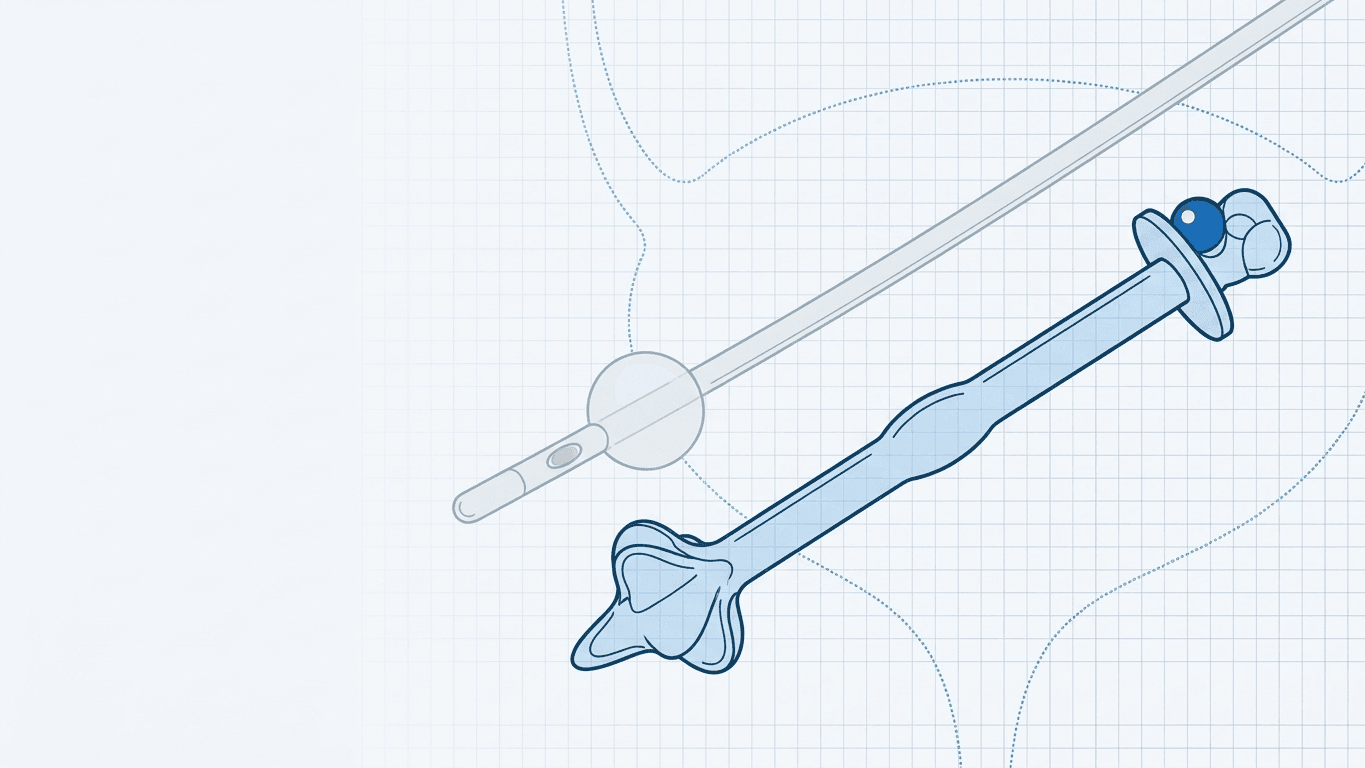
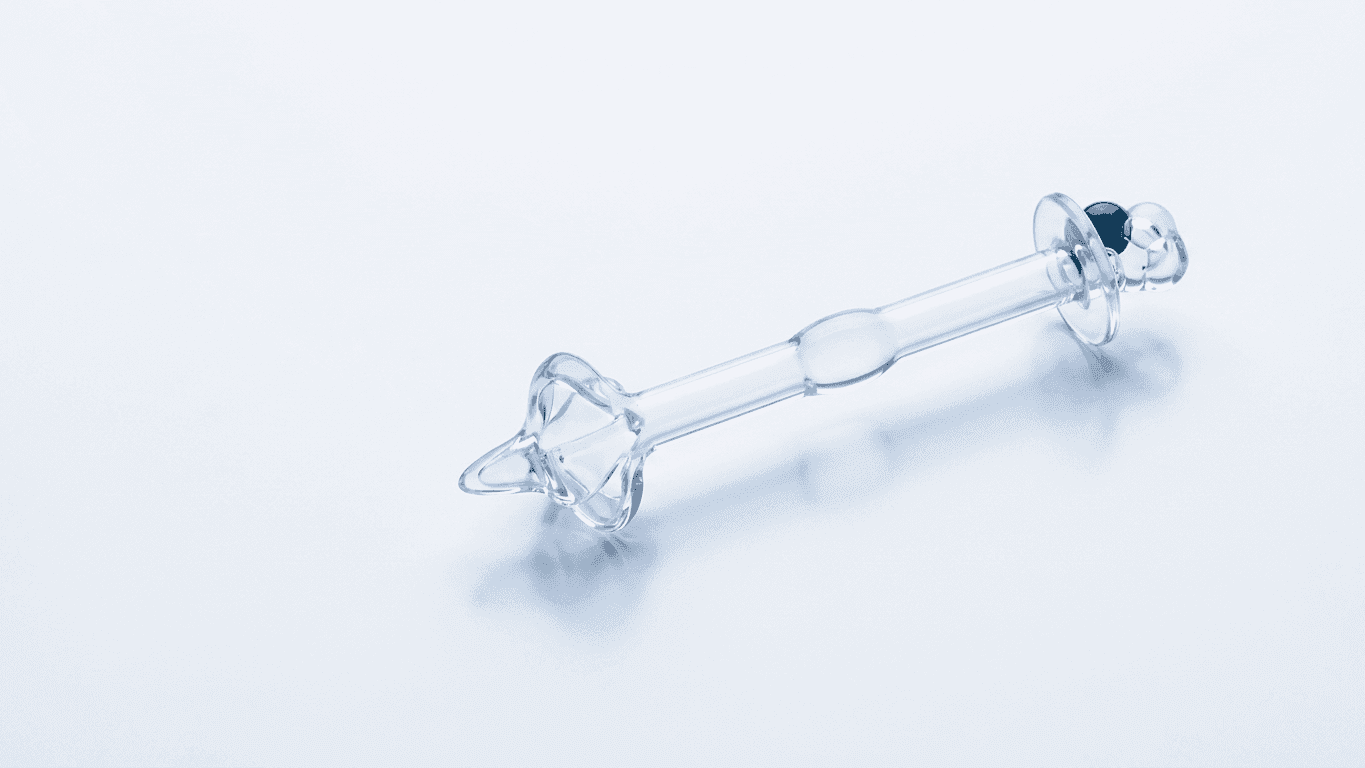
The registered device consists of a silicone-rubber shaft — with a baffle, a sealing ring and a four-lobed (quatrefoil) tip — a polytetrafluoroethylene (PTFE) ball bead and a stainless-steel push rod used for insertion. It is sterilised with ethylene oxide and supplied sterile.1
How the catheter works
Conventional indwelling catheters are held in the bladder by an inflated balloon and drain continuously. Silicon Life’s catheter takes a different approach. The quatrefoil tip sits at the bladder neck and keeps the catheter in place without a balloon, while the baffle rests outside the urethral meatus. Between voids, the ball bead seals the catheter. To void, the patient or carer squeezes the ball bead into a bulged section of the shaft, and the bladder empties through the catheter; squeezing it back closes the catheter again. Because there is no balloon or inflation channel, removal does not depend on deflating a balloon.
A healthcare professional places the catheter and replaces it after up to 30 days. The company’s line comprises 11 models across three effective lengths (35, 45 and 55 mm) and three French sizes (Fr 12, 16 and 20), including Max models with a reinforced sealing ring. Full details are on the product page.
The first clinical study
The catheter was evaluated in an interventional, single-centre, single-arm study at Tongji Hospital, Tongji Medical College, Huazhong University of Science and Technology, between January and June 2025. The study enrolled 23 women who could not void voluntarily because of detrusor underactivity, detrusor–sphincter dyssynergia, central nervous system injury, stress incontinence or voiding dysfunction after stroke. Each participant used one catheter for 30 days.2
- Primary endpoint: convenience and comfort of placement, voiding and indwelling, assessed as a combined score of at least 4.
- Result: in the per-protocol set, 18 of 19 participants (94.7%; 95% CI 74.0–99.9%) reached the threshold, against a prespecified target of 70% (p = 0.0186).2
- Safety: no adverse events occurred among the 19 participants who completed the study. Four participants withdrew after the catheter dislodged or was removed because of discomfort. All four events were moderate and non-serious and resolved without sequelae; the investigators attributed them to a mismatch between patient anatomy and the two catheter sizes used.2
The study has clear limits. It was small, conducted at one centre and had no control group. Only two models were tested — a 6.5 mm shaft in 35 mm and 45 mm lengths — which led the investigators to recommend a wider range of sizes.2 It was not designed to measure urinary tract infection, to compare the catheter with a conventional Foley catheter or catheter valve, or to follow women through repeated monthly replacements.
What this registration does not cover
- The catheter is registered only in the People’s Republic of China. It is not registered, cleared or approved in any other market.
- It is indicated for female patients with voiding dysfunction and is not indicated for men.
- The study results apply to the population and models studied; they are not evidence of superiority over other catheters.
What comes next
The catheter is the first product from a platform that Silicon Life is extending in several directions: a male internal controllable catheter, a hydrophilic-coated version, a ready-to-use catheter kit and an antibacterial catheter. Further out, the company is developing an electronically controlled artificial bladder triggered by a brain–computer interface. All of these programmes are investigational, have not been approved by any regulatory authority and are not available for sale; they are described on the pipeline page.
Healthcare professionals can request the Instructions for Use and the clinical study report, and distributors and hospital groups can contact the partnerships team.
References
- 1National Medical Products Administration (NMPA). Medical device registration database search (registration no. 鄂械注准20252145807)
- 2Silicon Life. Clinical study report: Disposable Sterile Controlled Catheter in women unable to void voluntarily — interventional, single-centre, single-arm study, Tongji Hospital, January–June 2025 (unpublished; summary on the product page)
Silicon Life. Silicon Life’s controlled catheter: China registration and first clinical study. SILICON·LIFE Insights. 11 October 2026.

Silicon Life develops urological devices and implantable systems in Wuhan, China. Its Insights are written for healthcare professionals, with the sources for each article listed in full.
This article is provided for educational purposes for healthcare professionals. It does not constitute medical advice and does not replace the Instructions for Use of any device. Product availability and indications differ by country.
New articles on urology devices and implant engineering.
Clinical reviews, engineering notes and company news from Silicon Life, sent when new articles are published.
Occasional emails. Unsubscribe at any time.