The validation scenario: why the reference choice changes the claim
A wireless bladder sensor report arrives with a recognizable pressure trace and a high correlation against a reference catheter. The next development decision is whether to proceed with an event detector, a quantitative pressure monitor or a system that estimates detrusor pressure. These are different claims. Before interpreting the headline number, ask what the reference measured, where it measured it and whether the comparison covered the conditions promised for the next stage.
The useful review outcome is a statement that connects a defined measurement to a defined test. For example, agreement with a lumen catheter during controlled filling supports a narrower conclusion than accurate detrusor-pressure monitoring during daily activity. This article maps that distinction across selected primary studies and provides questions an evaluation team can send back to a research partner. It does not rank devices or select a clinical monitoring method.
What pressure does a bladder sensor actually measure?
In clinical urodynamics, intravesical pressure (Pves) is the pressure measured within the bladder. Abdominal pressure (Pabd) contributes to that reading. Detrusor pressure (Pdet) is derived by subtracting the abdominal channel from the vesical channel. Calling a single intravesical trace “detrusor pressure” therefore requires additional evidence about how the abdominal component was measured or estimated.12
Sensor location adds another distinction. A diaphragm exposed to bladder fluid and a device enclosed within the bladder wall have different mechanical interfaces. In Basu and colleagues’ submucosal study, pressure changes could remain correlated in time while their magnitudes were attenuated. The authors considered tissue biomechanics a possible explanation; they did not establish a universal transfer function for every wall-mounted sensor.6
Use “absolute pressure” carefully. A device specification may mean pressure relative to a vacuum, pressure relative to atmosphere, or simply an unnormalized reading rather than a change from baseline. The report should state the actual convention and any barometric correction. Avoid using “absolute” as a synonym for both intravesical pressure and calibrated accuracy. A normalized trace, a gauge-pressure trace and a derived detrusor trace can look similar on a plot while supporting different conclusions.
Match the claim to the reference evidence
Use Table 1 at the start of a technical review. Its purpose is to expose missing links between the proposed claim and the measurement record. It does not prescribe a universal sampling rate, clock tolerance, allowable drift or preferred reference architecture. Those choices need a rationale tied to the intended measurement and the conditions being tested.
| Proposed claim | Reference evidence to request | Configuration to record | What remains unproven |
|---|---|---|---|
| Timing of pressure events | A defensible event reference and labeling method, with relevant non-target events included. | Whether labels came from simultaneous urodynamics, observation or another method; event matching and processing. | Capturing a pressure deflection does not establish its physiological origin or its amplitude. |
| Intravesical pressure magnitude | Paired measurements against an independently characterized bladder-pressure reference. | Lumen or wall placement; pressure convention; height, posture, calibration and analysis window. | Agreement in a chamber or during anesthesia does not establish agreement during daily activity. |
| Derived detrusor pressure | A contemporaneous abdominal measurement, or an independently validated estimator with its limits stated. | How Pves and Pabd share a reference convention and are aligned before subtraction. | A vesical-only accuracy result cannot be relabeled as measured Pdet. Estimated Pdet needs separate validation. |
| A pressure-dependent derived endpoint | Evidence that all inputs and their relevant frequency or baseline behavior remain valid. | Which pressure signal enters the calculation; any volume input, corrections and excluded intervals. | A successful transient comparison leaves slow baseline behavior and other inputs open. |
| Ambulatory pressure performance | A reference strategy or other evaluation endpoint suited to the actual activity claim. | Which activities had simultaneous reference data and which were only observed qualitatively. | A long recording alone cannot establish accuracy throughout periods without a reference. |
Source: Editorial synthesis of the measurement and study limitations in sources 1–6; proposed reporting fields, not a standard or device recommendation.
The last column is often the most useful part of the meeting. It gives the team a way to accept a supported result while keeping a broader claim open. A study can demonstrate technical feasibility without establishing diagnostic performance. Conversely, a narrow event-detection objective need not be rejected merely because the device does not directly measure an abdominal channel.
What can go wrong with an abdominal reference?
The abdominal channel is itself a measurement. Rosier describes intrarectal recording and an alternative vaginal route, and notes that rectal activity can alter the derived detrusor trace. A local rectal signal should not automatically be treated as a change in bladder muscle activity. For a research comparison, ask how reference quality was assessed and how suspicious intervals were annotated.2
The same paper examined a retrospective sample of 136 adult cystometries using external water-filled transducers. Initial derived resting pressures were imbalanced or nonphysiological in 62% under the study definition. The findings concerned signal quality around the start of testing and correction of pressure-line problems; they are not a failure rate for implantable sensors. The study also cautions against forcing intracorporeal pressures to zero as a substitute for restoring a valid signal.2
A useful reference record retains the original trace, quality annotations and the reason for any correction. If an interval was excluded because the reference was unreliable, say which channel was affected and why the comparison could not be interpreted. Correcting the test device to agree with a questionable reference can make the plot neater while leaving the physical measurement uncertain.
Primary studies: keep the reference and test phase beside the result
Table 2 compares selected examples for their measurement lessons. It is not a systematic review or a pooled accuracy estimate. The studies differ in species, placement, recording conditions and analysis. Several share investigators and technology development histories, so they should not be counted as independent replication of one device.
| Study and setting | Measurement and reference | Relevant finding | Boundary for the evaluator |
|---|---|---|---|
| Rosier, 2021: retrospective clinical series, 136 adult cystometries.2 | External water-filled bladder and rectal pressure channels. | Initial signal plausibility changed after pressure-line correction and some filling. | Clinical reference quality needs checking. These findings do not prescribe an implant calibration procedure. |
| Frainey et al., 2023: first-in-human feasibility, 11 women with overactive-bladder symptoms.3 | UroMonitor vesical pressure versus simultaneous catheter urodynamics; a separate ambulatory phase followed catheter removal. | 85 of 87 urodynamic events were captured; these included stress maneuvers as well as voiding and nonvoiding events. | Two participants were excluded from quantitative pressure analysis because of radio interference. Low-volume agreement was limited. The previously developed abdominal-event discrimination algorithm was not used in this study. |
| Majerus et al., 2024 journal issue: preclinical UroMOCA study, 11 felines, including nine active survival implants.4 | Bench chamber reference and catheter-based bladder-pressure reference during anesthetized cystometry. | Reported bench accuracy was about ±1.1 cmH₂O over 0–200 cmH₂O; anesthetized pressure traces had R² > 0.96. | Conscious recordings had no reference sensor and were interpreted qualitatively. Six of nine active devices functioned for the full 28-day period. Bench performance is not ambulatory accuracy. |
| Soebadi et al., 2019: awake study in five minipigs.5 | Bladder Pill and an air-charged catheter placed together in the bladder; no abdominal measurement for Pdet. | The reference catheter showed unexpectedly reduced pressure variation in four of 25 filling cycles. | The authors discuss possible reference drift and timestamp misalignment. This does not prove the test sensor was correct wherever the reference differed. |
| Basu et al., 2019 journal issue: six devices in five calves.6 | Submucosal sensor versus an intravesical water-filled catheter; manual compressions were contraction surrogates. | Table 3 compression correlations range from 0.81 to 0.99; full 300-second traces had correlations of 0.55 and 0.38. | Peak magnitudes were attenuated, and all devices left the bladder wall within four weeks. Transient correlation did not establish reliable pressure magnitude. |
Source: Original studies 2–6. Values are reported within their own study settings; no cross-device performance ranking is intended.
What does event capture establish without an abdominal channel?
A system can record useful events while leaving their origin or magnitude uncertain. The UroMonitor study is especially instructive: comparison against urodynamics and catheter-free ambulatory observation were separate phases. The reported event capture does not demonstrate that an onboard algorithm automatically distinguished abdominal events from detrusor contractions. The authors explicitly say their earlier classification algorithm was not used in this investigation.3
For an event-classification claim, request a definition of each target event, an independent labeling method, handling of ambiguous events and performance on non-target activity. A pressure rise during movement matters because it can resemble a target event. A report should show whether such examples were present in the evaluation rather than implying that recognizable waveforms solve classification. A detector used to trigger an intervention also needs evaluation of that intended use; event capture alone does not demonstrate therapeutic benefit.
The related wireless data-completeness worksheet addresses the separate question of which expected samples or events were actually available for analysis. Here, the question is whether the available reference supports the stated interpretation of those events.
How do time alignment and filtering change the comparison?
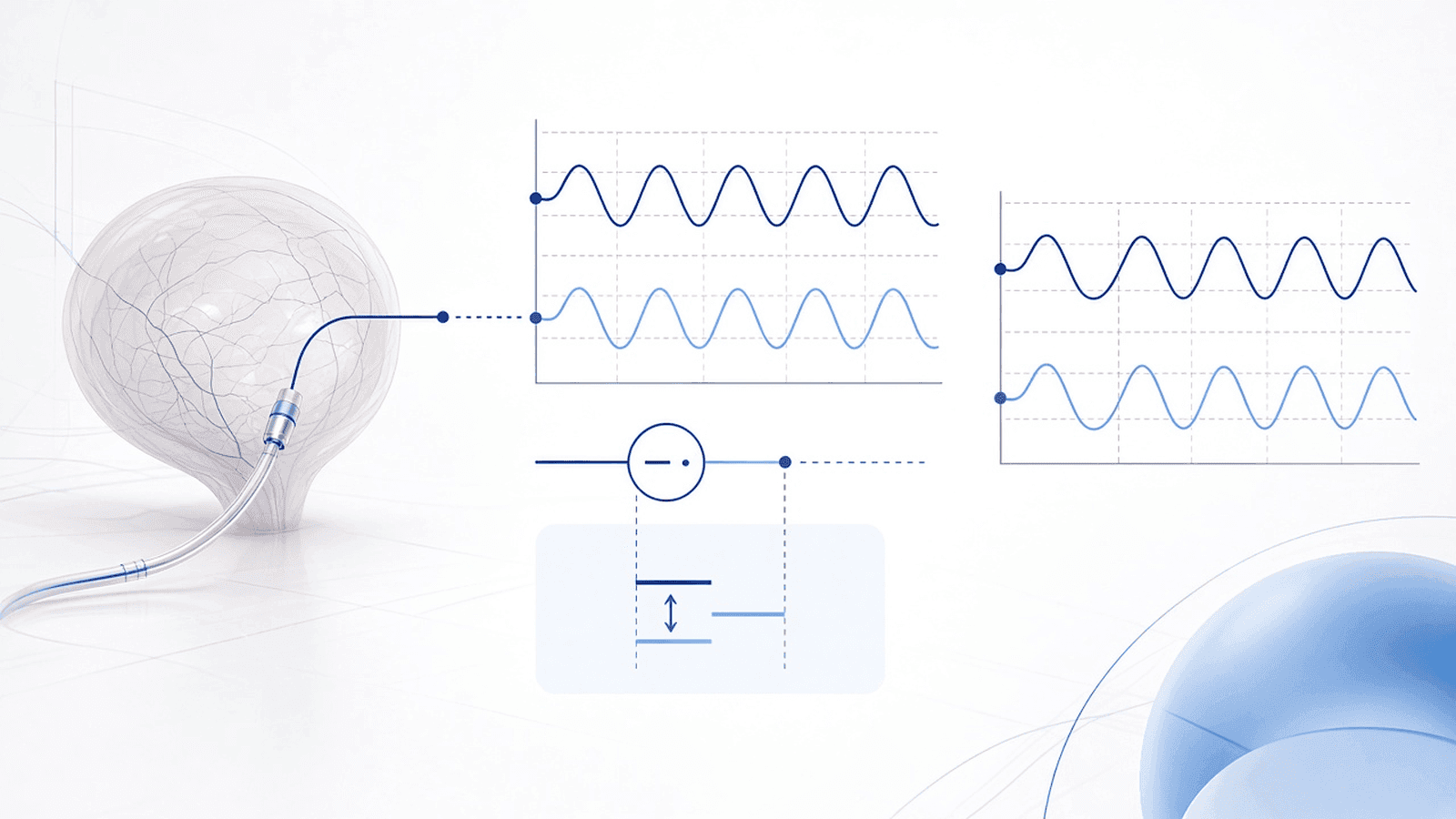
Two channels can respond to the same physical disturbance at different recorded times. If a common signal is represented as A(t) on one channel and A(t − δ) on another, their subtraction leaves A(t) − A(t − δ) rather than zero. This is a mathematical illustration of a timing artifact, not a measured patient waveform or a prediction of its size. Filter delay, separate clocks and post-processing alignment therefore belong in the report.
Soebadi and colleagues identify slight misalignment of separately registered pressure timestamps as a possible contributor to differences. UroMOCA sampled pressure internally at 75 Hz and low-pass filtered it to a 0.5 Hz bandwidth to address motion and abdominal-pressure artifacts. That is a particular design choice, not a sampling requirement established for every bladder sensor.54
Ask where timestamps were assigned, how clock differences were assessed, which filters were applied to each channel and whether alignment was corrected afterward. If alignment or normalization parameters were fitted to the evaluation data, distinguish those fitted results from prospective performance. Preserve unprocessed data and document transformations so the next reviewer can understand what the agreement statistic actually compares.
Zero level, hydrostatic offset and posture
ICS guidance distinguishes the atmospheric zero from the anatomical reference height. For conventional external fluid-filled systems, the reference height is the upper edge of the symphysis pubis. Maintaining an explicit reference convention supports interpretation of individual pressures as well as their subtraction. It is not enough to argue that unidentified errors on both channels will cancel.12
There is also current debate about the clinical implications of zeroing. A 2026 structured review, accompanied by three illustrative same-session assessments, found different baseline values but similar derived detrusor pressures and unchanged diagnostic conclusions in those examples. The authors reported a lack of comparative outcome evidence supporting one zeroing approach. These small illustrations do not establish implant accuracy or replace ICS guidance, but they argue against claiming that every baseline convention necessarily changes a clinical conclusion. For engineering review, preserve the reference convention and assess the actual output being claimed.9
For a catheter-free or implanted device, request the equivalent physical description rather than copying an external-transducer procedure. Where is the sensing surface relative to the comparison point? Can either move with posture or filling? What changes were measured, corrected or left uncharacterized? Do not assume an air–fluid interface inside a fluid-filled bladder or infer a fixed hydrostatic offset from a nominal filling volume. Location and orientation must be described for the actual test.
Reference choice and sensor stability are connected but separate questions. The sensor-drift evidence guide explains offset and sensitivity over time. A stable transducer can still be compared at an inappropriate reference level; a well-described reference level can still accompany a drifting transducer.
A reporting checklist for the evaluation meeting
Table 3 turns the distinctions into an evidence request. Adapt the fields to the intended claim and ask the investigators to justify the acceptance criteria they selected. The published studies do not supply one universal clock-error limit, pressure-drift tolerance or pressure-accuracy threshold for all applications.
| Review field | Question to send the research team | Record to request | Consequence of a gap |
|---|---|---|---|
| Quantity and claim | Is the endpoint event timing, Pves, Pdet derived from measured channels or estimated Pdet? | A claim statement linked to the specific output and comparison. | Narrow the conclusion to the quantity actually tested. |
| Physical reference | Which sensor and anatomical site generated each reference signal? | Configuration diagram, reference identification and calibration description. | Device-to-device agreement may lack an interpretable physiological meaning. |
| Reference convention | What atmospheric zero, height, posture and location corrections were used? | Test-condition record with correction history. | An offset cannot automatically be assigned to the investigational sensor. |
| Reference quality | How were artifacts, local activity or poor pressure transmission recognized? | Annotated paired traces and reasons for rejecting or correcting intervals. | The apparent test-device error may include reference error. |
| Time and processing | How were clocks, filters, resampling and alignment handled? | Processing sequence and assessment of remaining timing differences. | Transient differences may reflect the analysis chain. |
| Agreement analysis | What bias and spread remain across the conditions of interest? | Paired differences, suitable agreement analysis and participant-level results. | Correlation alone cannot substantiate interchangeable pressure readings. |
| Transfer to intended setting | Which claimed activities actually had a simultaneous reference? | A phase-by-phase map of reference availability and tested conditions. | Qualitative ambulatory observation cannot inherit controlled-test accuracy. |
Source: Proposed editorial worksheet derived from the limitations in sources 1–6. It does not establish regulatory submission requirements.
A worked review decision without invented performance targets
Consider a hypothetical report that presents a chamber calibration, a catheter comparison during anesthesia and an ambulatory trace without a reference. The summary calls all three “continuous detrusor-pressure validation.” The first repair is to label the chamber result as bench pressure agreement, the catheter comparison as in vivo vesical-pressure agreement under its tested conditions, and the ambulatory recording as observation without quantitative reference confirmation. None of those records alone establishes abdominal subtraction.
The next request should follow the missing claim: an abdominal reference strategy or independently tested estimator, common reference conventions, time alignment and appropriate agreement analysis. If the immediate development decision concerns event timing instead, define that narrower endpoint and its labeling evidence. This keeps a useful feasibility result while making the additional work visible. The example is a reporting exercise, not a clinical recommendation or a finding about any named manufacturer.
Evidence limits and update needs
Sources were checked on 9 November 2026. These selected studies illustrate reference-method problems rather than exhaust the literature. Clinical external-transducer findings, animal implants and a small human feasibility study cannot be pooled into a universal accuracy benchmark. Agreement within a selected window also leaves the remaining use conditions open. New direct comparisons of reference strategies, revisions to ICS guidance or corrections to these studies should trigger a review of the map. No company validation result or achieved development target is inferred from third-party research.
Where Silicon Life fits
Silicon Life (Wuhan Guiji Shengming Medical Technology Co., Ltd.) develops urological devices and investigational implantable systems. Its research pipeline includes an electronically controlled artificial bladder. These company programmes remain investigational and unavailable for sale; the studies above do not validate Silicon Life’s sensing performance.8
The company’s Disposable Sterile Controlled Catheter is a separate Class II device registered in China only (鄂械注准20252145807), indicated for female patients with voiding dysfunction. Its registration does not establish authorization for an implantable pressure monitor or availability in other markets. The controlled-catheter product page describes that limited scope.7
Research teams can use the reference-method worksheet when preparing a research-collaboration enquiry. Silicon Life’s pipeline programmes remain investigational; a collaboration discussion does not imply clinical availability, approval or a validated performance claim.8
Frequently asked questions
Is a rectal catheter the only abdominal reference?
No. Clinical guidance also discusses vaginal measurement. Other research architectures need their own evidence about what they measure and how well they represent the abdominal contribution. The relevant question is whether the proposed reference or estimator supports the stated endpoint, not whether one anatomical route is universally best.2
Does high correlation prove pressure accuracy?
No. Signals can change together while differing in offset or amplitude. Basu’s submucosal example illustrates the importance of location and analysis window. Request pressure differences and their spread across the claimed conditions as well as correlation; do not treat a transient association as a full-range magnitude validation.6
Can one implanted sensor be compared with another?
Yes, but the comparison establishes agreement between those devices under those conditions. It leaves open errors they share and any uncertainty in the reference. Ask for independent characterization of the comparator, its physical location and the chain connecting the measured output to a known pressure. A second sensor is not automatically ground truth.
What should we ask when an accuracy claim omits its reference?
Request the measured quantity, comparator, location, reference convention, test conditions and analysis window. Ask whether the stated value came from a bench chamber, a simultaneous in vivo comparison or an unreferenced recording. Until that information is available, record the claim as insufficiently specified rather than assigning it an assumed clinical meaning.
References
- 1Rosier PFWM, Schaefer W, Lose G, et al. International Continence Society Good Urodynamic Practices and Terms 2016: Urodynamics, uroflowmetry, cystometry, and pressure-flow study. Neurourology and Urodynamics, 2017;36(5):1243–1260. doi: 10.1002/nau.23124. Clinical measurement principles are also discussed in source 2.
- 2Rosier PFWM. Good urodynamic practice: Pressure signal quality immediately after catheter insertion for cystometry with a water-filled pressure transducer system and its relevance for the ICS zero procedure. Neurourology and Urodynamics, 2021;40(1):319–325. doi: 10.1002/nau.24561; PMID 33141486.
- 3Frainey BT, Majerus SJA, Derisavifard S, Lewis KC, Williams AR, Balog BM, Butler RS, Goldman HB, Damaser MS. First in Human Subjects Testing of the UroMonitor: A Catheter-free Wireless Ambulatory Bladder Pressure Monitor. Journal of Urology, 2023;210(1):186–195; doi: 10.1097/JU.0000000000003451 (PMC11675714, PMID 37293725).
- 4Majerus SJA, Hanzlicek B, Hacohen Y, Cabal D, Bourbeau D, Damaser MS. Wireless and Catheter-Free Bladder Pressure and Volume Sensor. IEEE Sensors Journal, 2024;24(6):7308–7316; published online 2023. doi: 10.1109/JSEN.2023.3267749.
- 5Soebadi MA, Bakula M, Hakim L, Puers R, De Ridder D. Wireless intravesical device for real-time bladder pressure measurement: Study of consecutive voiding in awake minipigs. PLOS ONE, 2019;14(12):e0225821. doi: 10.1371/journal.pone.0225821.
- 6Basu AS, Majerus S, Ferry E, Makovey I, Zhu H, Damaser MS. Is submucosal bladder pressure monitoring feasible? Proceedings of the Institution of Mechanical Engineers, Part H: Journal of Engineering in Medicine, 2019;233(1):100–113; published online 2018. doi: 10.1177/0954411918754925; PMID 30799738.
- 7Silicon Life. Disposable Sterile Controlled Catheter: public registration scope and indication. Company product page.
- 8Silicon Life. Research pipeline: investigational programmes and development boundaries. Company scope only; not independent evidence of sensor performance.
- 9Pereira do Nascimento LA, Pereira Pinto VB, Costa CH, Gomes CM. Zeroing Pressures in Urodynamics: Revisiting Current Practice and Pressure Interpretation. Neurourology and Urodynamics, first published 31 July 2026. doi: 10.1002/nau.70394. Structured review with three illustrative paired clinical assessments.
Silicon Life. Bladder sensor validation: why the pressure reference changes the result. SILICON·LIFE Insights. 9 November 2026.

Silicon Life develops urological devices and implantable systems in Wuhan, China. Its Insights are written for healthcare professionals, with the sources for each article listed in full.
This article is provided for educational purposes for healthcare professionals. It does not constitute medical advice and does not replace the Instructions for Use of any device. Product availability and indications differ by country.
New articles on urology devices and implant engineering.
Clinical reviews, engineering notes and company news from Silicon Life, sent when new articles are published.
Occasional emails. Unsubscribe at any time.